Instructions for Side by Side Printing
- Print the notecards
- Fold each page in half along the solid vertical line
- Cut out the notecards by cutting along each horizontal dotted line
- Optional: Glue, tape or staple the ends of each notecard together
Chp 1 & 2 Homework PCB
front 1 The BIO (Biotechnology Industry Organization) meeting held in Philadelphia in June 2005 brought together worldwide leaders from the biotechnology and pharmaceutical industries. Concurrently, BioDemocracy 2005, a group composed of people seeking to highlight hazards from widespread applications of biotechnology, also met in Philadelphia. The benefits of biotechnology are outlined in your text. Predict some of the risks that were no doubt discussed at the BioDemocracy meeting. | back 1 -Safety of genetically modified organisms to human health. -Ecological harmony. -Biotechnical applications to weapons development |
front 2 To understand how cells function as the fundamental unit of life, you must first become familiar with the individual roles of the cellular structures and organelles. | back 2 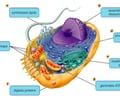 |
front 3 Two fundamental types of cells are known to exist in nature: prokaryotic cells and eukaryotic cells (like the one shown in the Tour of an Animal Cell animation). Both prokaryotic and eukaryotic cells carry out all of the processes necessary for life, but they differ in some important ways. In this activity, you will identify which cell structures are found only in prokaryotic cells, only in eukaryotic cells, or in both types of cells. | back 3 pro- nucleoid euk- nucleolus, lysosome, mitochondria both- ribosomes, plasma membrane, flagella |
front 4  | back 4 |
front 5 Which list of steps in the eukaryotic cell cycle is given in the correct order? (step order listed left to right) | back 5 . . . G1 - S - G2 - M - G1 . . . |
front 6 Haploid cells do not undergo mitosis. | back 6 False |
front 7 Each of the following events occurs during mitosis except _______. | back 7 polar microtubules contract, pulling attached chromosomes toward the poles |
front 8 As in most areas of biology, the study of mitosis and the cell cycle involves a lot of new terminology. Knowing what the different terms mean is essential to understanding and describing the processes occurring in the cell. | back 8 1. DNA replication produces two identical DNA molecules, called
SISTER CHROMATID(S), which separate during mitosis. |
front 9 Many organisms contain cells that do not normally divide. These cells exit the cell cycle before the G1 checkpoint. Once a cell passes the G1 checkpoint, it usually completes the cell cycle--that is, it divides.
| back 9 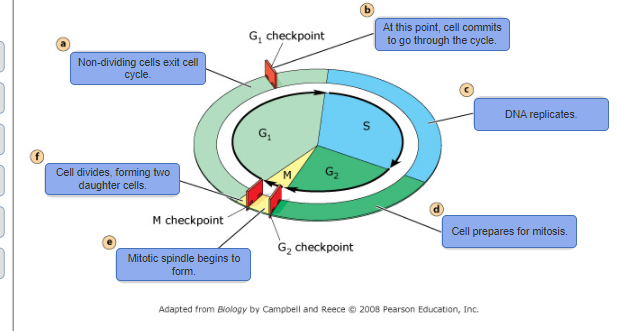 |
front 10 As the chromosomes of a parent cell are duplicated and distributed to
the two daughter cells during cell division, the structure of the
chromosomes changes. | back 10 Are sister chromatid present in all or part of this phase? |
front 11 Separation of sister chromatids occurs _______ | back 11 at anaphase in mitosis and anaphase II in meiosis |
front 12 The end result of meiosis is four haploid daughter cells. | back 12 true |
front 13 Novel combinations of genes can arise from _______. | back 13 reciprocal exchange of DNA between homologs during prophase ISubmit |
front 14 The phenotype of an organism is _______. | back 14 the observed features of an organism |
front 15 The haploid number of a species is _______. | back 15 n (the haploid number is the number of chromosomes in gametes after meiosis.) |
front 16 The functional unit of heredity is a _______. | back 16 gene |
front 17 The theory of epigenesis states that _______. | back 17 adult structures in the organism develop de novo from substances present in the egg |
front 18 What are some of the impacts of biotechnology on crop plants in the United States? | back 18 all of them - Quicker identification of hazardous organisms in food |
front 19 What is an example of translational medicine? | back 19 A gene product associated with lower cholesterol levels is used to develop a treatment for high cholesterol. |
front 20 If you were in a position to control the introduction of a GM primary food product (rice, for example), what criteria would you establish before allowing such introduction? | back 20 -likelihood of cross-pollination |
front 21 Summarize the arguments for and against patenting genetically modified organisms. | back 21 For Patenting: |
front 22 During which stage of prophase I does crossing over take place? | back 22 Pachynema (Crossing over occurs during pachynema when bivalents are closely paired.) |
front 23 A tetrad is composed of one pair of homologous chromosomes at synapsis of prophase I. | back 23 true (Chromosomes are duplicated during interphase; at synapsis of prophase I, one chromosome (with two chromatids) in a tetrad is paternally inherited while the other is maternally inherited.) |
front 24 When do sister chromatids separate during meiosis? | back 24 Anaphase II |
front 25 How has the use of model organisms advanced our knowledge of the genes that control human diseases? | back 25 ... |
front 26 What are the basic subunits of DNA and RNA? | back 26 nucleotides |
front 27 Define genotype and phenotype. | back 27
|
front 28 How do alleles fit into your definitions? | back 28 -A population can contain many alleles for a gene, but an individual diploid organism has only two alleles for a gene. -Alleles are alternative forms of a gene. -Differenet alleles may produce differences in the phenotype of an organism. |
front 29 Why do you think discoveries in genetics have been recognized with so many Nobel Prizes? | back 29 -Genetics guided our understanding of living systems. -Genetics aided rational drug design. -Genetics helps to explain species stability and diversity. -Genetics provides the framework for universal biological processes. |
front 30 How does genetic information flow in an organism? | back 30 DNA → RNA → protein |
front 31 Contrast chromosomes and genes. | back 31 Genes take part in the production of proteins through the processes of transcription and translation. They are the functional units of heredity. Chromosomes carry genes and take part in cell division during mitosis and meiosis. |
front 32 Which term describes the complete haploid content of DNA contained within an organism? | back 32 genome |
front 33 How is genetic information encoded in a DNA molecule? | back 33 Genetic information is encoded in DNA by the sequence of bases. |
front 34 The study of the set of proteins present in a cell is referred to as _______. | back 34 proteomics |
front 35 Identify the central dogma of molecular genetics. | back 35 DNA →→ RNA →→ protein |
front 36 How does the central dogma of molecular genetics serve as the basis of modern genetics? | back 36 Because DNA and RNA are discrete chemical entities, they can be isolated, studied, and manipulated in a variety of experiments that define modern genetics. |
front 37 What is the chromosome theory of inheritance? | back 37 It states that inherited traits are controlled by genes residing on chromosomes that are transmitted by gametes.Submit |
front 38 How is it related to Mendel's findings? | back 38 The chromosome theory of inheritance is based on the parallels between Mendel's model of heredity and the behavior of chromosomes during meiosis.Submit |
front 39 Describe Mendel's conclusions about how traits are passed from generation to generation. | back 39 Mendel hypothesized that traits in peas are controlled by specific unit factors. He suggested that unit factors occur in pairs and that unit factors separate from each other during gamete formation.Submit |
front 40 All of the following are desirable qualities in a model organism EXCEPT __________. | back 40 long life span |
front 41 How many different proteins, each with a unique amino acid sequence, can be constructed with a length of 4 amino acids? | back 41 Since each of the 20 amino acids is chemically distinct and each can, in principle, occur at any position in a protein chain, there are 20 × 20 × 20 × 20 = 160,000 different possible |
front 42 Given the state of knowledge at the time of the Avery, MacLeod, and McCarty experiment, why was it difficult for some scientists to accept that DNA is the carrier of genetic information? | back 42 Genes possess a variety of functions. Since proteins can contain up to 20 different amino acids, while DNA is made up of only four different nucleotides, proteins should have more functional variations. It seemed likely that proteins should be the genetic material.Submit |
front 43 Which of the following cell structures are directly involved in protein synthesis? | back 43 rough endoplasmic reticulum and ribosomes (Ribosomes are the sites of protein translation, and some ribosomes attach to the rough endoplasmic reticulum.) |
front 44 If you wrote a brief essay discussing the impact of recombinant DNA technology on genetics as we perceive the discipline today, what applications of recombinant DNA technology should be included? | back 44 -Plant and animal husbandry |
front 45 We all carry about 20,000 genes in our genome. So far, patents have been issued for more than 6000 of these genes. What are the arguments for and against human gene patenting by companies and individuals? | back 45 -Mechanisms need to be in place to protect consumers to ensure that
relatively free and fair access to genetic tools is
available. Patents can protect the investments of individuals and institutions that develop needed and useful products. |
front 46 Mechanisms need to be in place to protect consumers to ensure that
relatively free and fair access to genetic tools is
available. | back 46 acrocentric chromosome |