Print Options

Card layout: ?

← Back to notecard set|Easy Notecards home page

Instructions for Side by Side Printing
  1. Print the notecards
  2. Fold each page in half along the solid vertical line
  3. Cut out the notecards by cutting along each horizontal dotted line
  4. Optional: Glue, tape or staple the ends of each notecard together
  1. Verify Front of pages is selected for Viewing and print the front of the notecards
  2. Select Back of pages for Viewing and print the back of the notecards
    NOTE: Since the back of the pages are printed in reverse order (last page is printed first), keep the pages in the same order as they were after Step 1. Also, be sure to feed the pages in the same direction as you did in Step 1.
  3. Cut out the notecards by cutting along each horizontal and vertical dotted line
To print: Ctrl+PPrint as a list

39 notecards = 10 pages (4 cards per page)

Viewing:

Biology Module 6: Mendelian Genetics

front 1

Use the following information to answer the questions below.

Two true-breeding stocks of pea plants are crossed. One parent has red, axial flowers and the other has white, terminal flowers; all F1 individuals have red, axial flowers. The genes for flower color and location assort independently.


Among the F2 offspring, what is the probability of plants with white axial flowers?

back 1

3/16

front 2

Which of the following provides an example of epistasis?

back 2

In rabbits and many other mammals, one genotype (cc) prevents any fur color from developing.

front 3

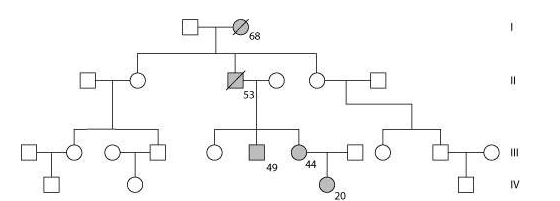
Use the following pedigree (Figure 14.3) for a family in which dark-shaded symbols represent individuals with one of the two major types of colon cancer. Numbers under the symbols are the individual's age at the time of diagnosis.


Figure 14.3


What is the genotype of the deceased individual in generation II?

back 3

heterozygous for a gene for colon cancer

front 4

Use the following information to answer the questions below.

Radish flowers may be red, purple, or white. A cross between a red-flowered plant and a white-flowered plant yields all-purple offspring. The part of the radish we eat may be oval or long, with long being the dominant characteristic.


In the F2 generation of the above cross, which of the following phenotypic ratios would be expected?

back 4

6:3:3:2:1:1

front 5

Use the information given here to answer the following questions.

Feather color in budgies is determined by two different genes, Y and B, one for pigment on the outside and one for the inside of the feather. YYBB, YyBB, or YYBb is green; yyBB or yyBb is blue; YYbb
or Yybb is yellow; and yybb is white.


A blue budgie is crossed with a white budgie. Which of the following results is not possible?

back 5

green and yellow offspring

front 6

Use the following information to answer the questions below.

A woman who has blood type A positive has a daughter who is type O positive and a son who is type B negative. Rh positive is a trait that shows simple dominance over Rh negative and is designated by the alleles R and r, respectively. A third gene for the MN blood group has codominant alleles M
and N.


If both children are of blood type M, which of the following is possible?

back 6

Each parent is either M or MN.

front 7

Two plants are crossed, resulting in offspring with a 3:1 ratio for a particular trait. What does this suggest?

back 7

that the parents were both heterozygous for a single trait

front 8

Use the information given here to answer the following questions.

Feather color in budgies is determined by two different genes, Y and B, one for pigment on the outside and one for the inside of the feather. YYBB, YyBB, or YYBb is green; yyBB or yyBb is blue; YYbb
or Yybb is yellow; and yybb is white.


Two blue budgies were crossed. Over the years, they produced 22 offspring, 5 of which were white. What are the most likely genotypes for the two blue budgies?

back 8

yyBb and yyBb

front 9

Which of the following describes the ability of a single gene to have multiple phenotypic effects?

back 9

pleiotropy

front 10

Use the following information to answer the questions below.

A woman who has blood type A positive has a daughter who is type O positive and a son who is type B negative. Rh positive is a trait that shows simple dominance over Rh negative and is designated by the alleles R and r, respectively. A third gene for the MN blood group has codominant alleles M
and N.


Which of the following is a possible genotype for the mother?

back 10

IAi

front 11

Use the following information to answer the questions below.

Radish flowers may be red, purple, or white. A cross between a red-flowered plant and a white-flowered plant yields all-purple offspring. The part of the radish we eat may be oval or long, with long being the dominant characteristic.

The flower color trait in radishes is an example of which of the following?

back 11

incomplete dominance

front 12

What do we mean when we use the terms monohybrid cross and dihybrid cross?

back 12

A dihybrid cross involves organisms that are heterozygous for two characters and a monohybrid cross involves only one.

front 13

Use the following information to answer the questions below.

A woman who has blood type A positive has a daughter who is type O positive and a son who is type B negative. Rh positive is a trait that shows simple dominance over Rh negative and is designated by the alleles R and r, respectively. A third gene for the MN blood group has codominant alleles M
and N.


Which of the following is a possible phenotype for the father?

back 13

B positive

front 14

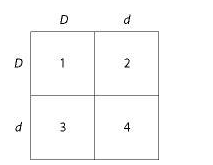
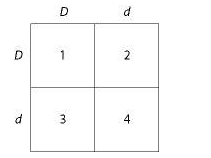
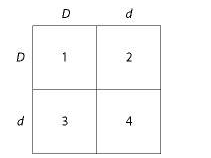
Use Figure 14.1 and the following description to answer the questions below.

In a particular plant, leaf color is controlled by gene locus D. Plants with at least one allele D have dark green leaves, and plants with the homozygous recessive dd genotype have light green leaves. A true-breeding dark-leaved plant is crossed with a light-leaved one, and the F1 offspring is allowed to self-pollinate. The predicted outcome of the F2 is diagrammed in the Punnett square shown in Figure 14.1, where 1, 2, 3, and 4 represent the genotypes corresponding to each box within the square.


Figure 14.1


Which of the plants will be true-breeding?

back 14

1 and 4 only

front 15

A sexually reproducing animal has two unlinked genes, one for head shape (H) and one for tail length (T). Its genotype is HhTt. Which of the following genotypes is possible in a gamete from this organism?

back 15

HT

front 16

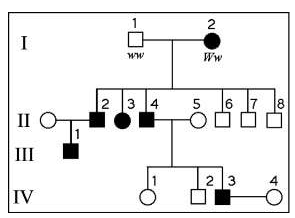
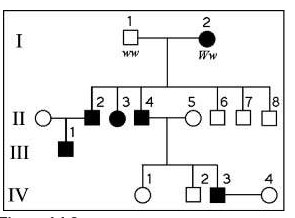
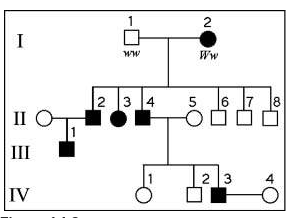
The following questions refer to the pedigree chart in Figure 14.2 for a family, some of whose members exhibit the dominant trait, W. Affected individuals are indicated by a dark square or circle.


Figure 14.2


What is the genotype of individual II-5?Correct!

back 16

ww

front 17

Given the parents AABBCc x AabbCc, assume simple dominance for each trait and independent assortment. What proportion of the progeny will be expected to phenotypically resemble the first parent?

back 17

3/4

front 18

Mendel accounted for the observation that traits which had disappeared in the F1 generation reappeared in the F2 generation by proposing that

back 18

traits can be dominant or recessive, and the recessive traits were obscured by the dominant ones in the F1.

front 19

Mendel's observation of the segregation of alleles in gamete formation has its basis in which of the following phases of cell division?

back 19

anaphase I of meiosis

front 20

Mendel's second law of independent assortment has its basis in which of the following events of meiosis I?

back 20

alignment of tetrads at the equator

front 21

Use the following information to answer the questions below.

Radish flowers may be red, purple, or white. A cross between a red-flowered plant and a white-flowered plant yields all-purple offspring. The part of the radish we eat may be oval or long, with long being the dominant characteristic.


If true-breeding red long radishes are crossed with true-breeding white oval radishes, the F1 will be expected to be which of the following?

back 21

purple and long

front 22

The following questions refer to the pedigree chart in Figure 14.2 for a family, some of whose members exhibit the dominant trait, W. Affected individuals are indicated by a dark square or circle.


Figure 14.2


What is the probability that individual III-1 is Ww?

back 22

1

front 23

Black fur in mice (B) is dominant to brown fur (b). Short tails (T) are dominant to long tails (t). What fraction of the progeny of crosses BbTt x BBtt
will be expected to have black fur and long tails?

back 23

1/2

front 24

Hydrangea plants of the same genotype are planted in a large flower garden. Some of the plants produce blue flowers and others pink flowers. This can be best explained by which of the following?

back 24

environmental factors such as soil pH

front 25

Use the following information to answer the questions below.

Tallness (T) in snapdragons is dominant to dwarfness (t), while red (R) flower color is dominant to white (r). The heterozygous condition results in pink (Rr) flower color.


If snapdragons are heterozygous for height as well as for flower color, a mating between them will result in what ratio?

back 25

6:3:3:2:1:1

front 26

Cystic fibrosis affects the lungs, the pancreas, the digestive system, and other organs, resulting in symptoms ranging from breathing difficulties to recurrent infections. Which of the following terms best describes this?

back 26

pleiotropy

front 27

The following questions refer to the pedigree chart in Figure 14.2 for a family, some of whose members exhibit the dominant trait, W. Affected individuals are indicated by a dark square or circle.


Figure 14.2


What is the likelihood that the progeny of IV-3 and IV-4 will have the trait?

back 27

50%

front 28

When crossing an organism that is homozygous recessive for a single trait with a heterozygote, what is the chance of producing an offspring with the homozygous recessive phenotype?

back 28

50%

front 29

Use the following information to answer the questions below.

Tallness (T) in snapdragons is dominant to dwarfness (t), while red (R) flower color is dominant to white (r). The heterozygous condition results in pink (Rr) flower color.


A dwarf, red snapdragon is crossed with a plant homozygous for tallness and white flowers. What are the genotype and phenotype of the F1 individuals?

back 29

TtRr-tall and pink

front 30

Use Figure 14.1 and the following description to answer the questions below.

In a particular plant, leaf color is controlled by gene locus D. Plants with at least one allele D have dark green leaves, and plants with the homozygous recessive dd genotype have light green leaves. A true-breeding dark-leaved plant is crossed with a light-leaved one, and the F1 offspring is allowed to self-pollinate. The predicted outcome of the F2 is diagrammed in the Punnett square shown in Figure 14.1, where 1, 2, 3, and 4 represent the genotypes corresponding to each box within the square.


Figure 14.1


Which of the boxes correspond to plants with a heterozygous genotype?

back 30

2 and 3

front 31

In the cross AaBbCc x AaBbCc, what is the probability of producing the genotype AABBCC?

back 31

1/64

front 32

Which of the following is an example of polygenic inheritance?

back 32

skin pigmentation in humans

front 33

Use the following information to answer the questions below.

Drosophila (fruit flies) usually have long wings (+) but mutations in two different genes can result in bent wings (bt) or vestigial wings (vg).


If a homozygous bent wing fly is mated with a homozygous vestigial wing fly, which of the following offspring would you expect?

back 33

all +bt +vg heterozygotes

front 34

Marfan syndrome in humans is caused by an abnormality of the connective tissue protein fibrillin. Patients are usually very tall and thin, with long spindly fingers, curvature of the spine, sometimes weakened arterial walls, and sometimes ocular problems, such as lens dislocation. Which of the following would you conclude about Marfan syndrome from this information?

back 34

It is pleiotropic.

front 35

Use the following information to answer the questions below.

A woman who has blood type A positive has a daughter who is type O positive and a son who is type B negative. Rh positive is a trait that shows simple dominance over Rh negative and is designated by the alleles R and r, respectively. A third gene for the MN blood group has codominant alleles M
and N.


Which of the following is a possible partial genotype for the son?

back 35

IBi

front 36

In certain plants, tall is dominant to short. If a heterozygous plant is crossed with a homozygous tall plant, what is the probability that the offspring will be short?

back 36

0

front 37

In cattle, roan coat color (mixed red and white hairs) occurs in the heterozygous (Rr) offspring of red (RR) and white (rr) homozygotes. Which of the following crosses would produce offspring in the ratio of 1 red:2 roan:1 white?

back 37

roan x roan

front 38

Use Figure 14.1 and the following description to answer the questions below.

In a particular plant, leaf color is controlled by gene locus D. Plants with at least one allele D have dark green leaves, and plants with the homozygous recessive dd genotype have light green leaves. A true-breeding dark-leaved plant is crossed with a light-leaved one, and the F1 offspring is allowed to self-pollinate. The predicted outcome of the F2 is diagrammed in the Punnett square shown in Figure 14.1, where 1, 2, 3, and 4 represent the genotypes corresponding to each box within the square.


Figure 14.1


Which of the boxes marked 1-4 correspond to plants with dark leaves?

back 38

1, 2, and 3

front 39

Use the following information to answer the questions below.

Drosophila (fruit flies) usually have long wings (+) but mutations in two different genes can result in bent wings (bt) or vestigial wings (vg).


If flies that are heterozygous for both the bent wing gene and the vestigial wing gene are mated, what is the probability of offspring with bent wings only?

back 39

3/16