Print Options

Card layout: ?

← Back to notecard set|Easy Notecards home page

Instructions for Side by Side Printing
  1. Print the notecards
  2. Fold each page in half along the solid vertical line
  3. Cut out the notecards by cutting along each horizontal dotted line
  4. Optional: Glue, tape or staple the ends of each notecard together
  1. Verify Front of pages is selected for Viewing and print the front of the notecards
  2. Select Back of pages for Viewing and print the back of the notecards
    NOTE: Since the back of the pages are printed in reverse order (last page is printed first), keep the pages in the same order as they were after Step 1. Also, be sure to feed the pages in the same direction as you did in Step 1.
  3. Cut out the notecards by cutting along each horizontal and vertical dotted line
To print: Ctrl+PPrint as a list

92 notecards = 23 pages (4 cards per page)

Viewing:

Exam 3

front 1

The most frequently used portal of entry for pathogens is the

  • skin
  • parental route
  • mucous membrane
  • All of these portals are used equally

back 1

mucous membrane

front 2

The ability of some microbes such as Trypanosoma or Giardia to alter their surface molecules and evade destruction by the host's antibodies is called

  • cytopathic effect
  • antigenic variation
  • virulence
  • cytocidal effect
  • lysogenic conversion

back 2

antigenic variation

front 3

Siderophores are bacterial proteins that complete with the host's

  • receptors
  • red blood cells
  • white blood cells
  • iron-transport proteins
  • antibodies

back 3

iron-transport proteins

front 4

Bacterium - ID50

E.coli O157:H7 - 20

Legionella pneumophilia - 1

Shigella - 10

Treponema pallidum - 57

Which organism in Table 15.2 most easily causes an infection?

  • Shigella
  • E.coli O157:H7
  • Treponema pallidum
  • Legionella pneumophilia
  • The answer cannot be determined based on the information provided

back 4

Legionella pneumophila

front 5

All of the following are used by bacteria to attach to host cells EXCEPT

  • A-B toxins
  • fimbriae
  • M protein
  • ligands
  • capsules

back 5

A-B toxins

front 6

Bacteria such as E.coli and Salmonella produce invasins that bind host cells, thus causing the cells to

  • release TNF
  • destroy the bacteria
  • engulf the bacteria
  • produce iron-binding proteins
  • release cytokines

back 6

engulf the bacteria

front 7

The best descriptions of direct damage by a pathogen is

  • poisonous substances secreted by viruses kill cells
  • host cells destroyed when pathogens metabolize and multiply
  • protein synthesis is interrupted by toxins
  • capsule components of pathogen kill cells
  • superantigens cause cytokine release which then cause symptoms of disease

back 7

host cells destroyed when pathogens metabolize and multiply

front 8

Many pathogens use the same portal for entry and exit from the body

  • True
  • False

back 8

True

front 9

For each of the following statements, select whether the statement BEST applies to exotoxins or endotoxins.

  1. Lipid portions of the outer membrane in gram-negative bacteria -
  2. Superantigens are a type of -
  3. Low LD50 -
  4. Can trigger low blood pressure and fever -

back 9

  1. Endotoxin
  2. Exotoxin
  3. Exotoxin
  4. Endotoxin

front 10

All of the following are examples of entry via the parenteral route EXCEPT

  • surgery
  • bite
  • injection
  • skin cute
  • ingestion

back 10

ingestion

front 11

Superantigens produce intense immune responses by stimulating lymphocytes to produce

  • exotoxins
  • cytokines
  • interferons
  • leukocidins
  • endotoxins

back 11

cytokines

front 12

Lysogenic bacteriophages contribute to bacterial virulence because bacteriophages

  • kill the bacteria, causing the release of endotoxins
  • produce toxins
  • carry plasmids
  • give new gene sequences to the host bacteria
  • kill human cells

back 12

give new gene sequences to the host bacteria

front 13

Polio is transmitted by ingestion of water contaminated with feces containing the polio virus. What portal of entry does the polio virus use?

  • skin, parenteral and mucous membranes
  • parenteral only
  • skin and parenteral
  • mucous membranes only
  • skin only

back 13

mucous membranes only

front 14

Most pathogens that gain access through the skin

  • enter through hair follicles and sweat ducts
  • must adhere first while their invasive factors allow them to penetrate
  • must be injected
  • just infect the skin itself
  • can penetrate intact skin

back 14

enter through hair follicles and sweat ducts

front 15

Antibiotics can lead to septic shock if used to treat

  • viral infections
  • Gram-positive bacterial infections
  • protozoan infections
  • gram-negative bacterial infections
  • helminth infestations

back 15

gram-negative bacterial infections

front 16

Which of the following is NOT a cytopathic effect of viruses?

  • toxin production
  • inclusion bodies forming in the cytoplasm or nucleus
  • cell death
  • host cells fusing to form multinucleated syncytia
  • increased cell growth

back 16

toxin production

front 17

The table shows the ID50 for Staphylococcus aureus in wounds with and without the administration of ampicillin before surgery. Based on the data, the administration of ampicillin before surgery

  • decrease the risk of staphylococcal infection
  • has no effect on risk of infection
  • increases the risk of staphylococcal infection
  • replaces tetracycline
  • The answer cannot be determined based on the information provided

back 17

decreases the risk of staohylococcal infection

front 18

Patients developed inflammation a few hours following eye surgery. Instruments and solutions were sterile, and the Limulus assay was positive. The patients' inflammation was due to

  • bacterial infection
  • exotoxin
  • endotoxin
  • viral infection
  • The answer cannot be determined based on the information provided

back 18

endotoxin

front 19

Match each of the following virulence factor with its effect

  • Capsules -
  • M protein -
  • Coagulase -
  • Ligands -

back 19

  • Evade phagocytosis
  • Evade phagocytosis
  • Forms fibrinogen clots
  • Adhere to host cells

front 20

A commensal bacterium

  • does not receive any benefit from its host
  • isn't capable of causing disease in its host
  • is beneficial to its host
  • may become an opportunistic pathogen
  • always cause disease in its host

back 20

may become an opportunistic pathogen

front 21

The rise in herd immunity amongst a population can be directly attributed to

  • None of the answers is correct
  • vaccinations
  • antibiotic-resistant microorganisms
  • improved handwashing
  • increased use of antibiotics

back 21

vaccinations

front 22

Which one of the following does NOT contribute to the incidence of healthcare-associated infections?

  • antibiotic resistance
  • lapse in aseptic techniques
  • gram-negative cell walls
  • lack of disinfecting surfaces
  • lack of handwriting

back 22

gram-negative cell walls

front 23

Which of the following is NOT a communicable disease?

  • AIDS
  • typhoid fever
  • tuberculosis
  • tetanus
  • malaria

back 23

tetanus

front 24

Which of the following is a fomite?

  • droplets from a sneeze
  • pus
  • insects
  • water
  • a hypodermic needle

back 24

a hypodermic needle

front 25

Which of the following statements about biological transmission is FALSE?

  • The pathogen may be injected by the bite of the vector
  • The pathogen reproduces in the vector
  • The pathogen may require the vector as a host
  • The pathogen may enter the host in the vector's feces
  • Houseflies are an important vector for biological transmission

back 25

Houseflies are an important vector for biological transmission

front 26

Symptoms of disease differ from signs of disease in that symptoms

  • are changes felt by the patient
  • are specific for a particular disease
  • are changes observed by the physician
  • always occur as part of a syndrome

back 26

are changes felt by the patient

front 27

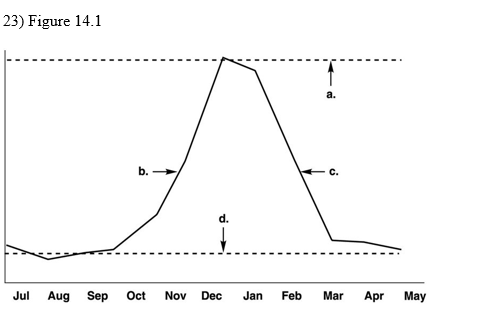
Shows the incidence of influenza during a typical year in the northern hemisphere. Which letter on the graph indicates the endemic level?

  • a
  • b
  • c
  • d

back 27

d

front 28

Which level indicates the gradual end of the epidemic outbreak?

  • c
  • d
  • b
  • a

back 28

c

front 29

A healthcare-associated infection (traditionally known as a nosocomial infection) is

  • always caused by pathogenic bacteria
  • always caused by medical personnel
  • only a result of surgery
  • always present, but is inapparent at the time of hospitalization
  • acquired during the course of hospitalization

back 29

acquired during the course of hospitalization

front 30

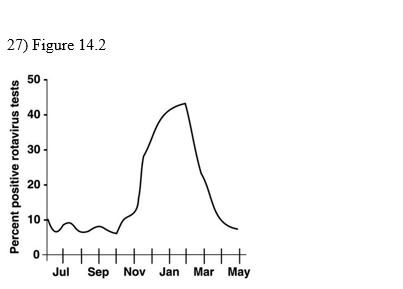
When is the prevalence the highest?

  • February
  • January
  • July
  • March

back 30

February

front 31

A disease in which the causative agent remains inactive for a time before producing symptoms is referred to as

  • subacute
  • latent
  • subclinical
  • acute
  • zoonotic

back 31

latent

front 32

In which of the following diseases can gender be considered a viable predisposing factor?

  • salmonellosis
  • anthrax
  • urinary tract infections
  • pneumonia
  • tetanus

back 32

urinary tract infections

front 33

The major significance of Robert Koch's work is that

  • microorganisms cause disease
  • diseases can be transmitted from one animal to another
  • microorganisms can be cultured
  • microorganisms are present in a diseased animal
  • microorganisms are the result of disease

back 33

microorganisms cause disease

front 34

The yeast Candida albicans does NOT normally cause disease because of

  • parasitic bacteria
  • commensal bacteria
  • other fungi
  • symbiotic bacteria
  • mutualistic bacteria

back 34

mutualistic bacteria

front 35

If a prodromal period exists for a certain disease , it should occur prior to

  • decline
  • incubation
  • convalescence
  • illness

back 35

illness

front 36

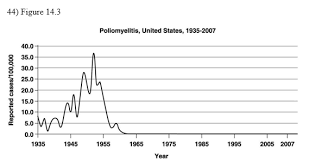
The graph shows the incidence of polio in the United States. The period 1945 and 1955 indicates a(n)

  • epidemic level
  • communicable disease
  • sporadic infection
  • pandemic
  • endemic level

back 36

epidemic level

front 37

Interpreting this graph, can we conclude that polio has been eradicated globally? Why or why not?

  • No, because the graph only depicts incidence of polio in the United States
  • No, because polio is part of the normal microbiota, and could become resurgent if vaccination efforts lapse
  • Yes, because a zero incidence rate for over 40 years clearly indicates there are no longer any susceptibles left in the global population
  • Yes, as the number of reported cases goes to zero around 1965

back 37

No, because the graph only depicts incidence of polio in the United States

front 38

Which of the following diseases is NOT spread by droplet infection?

  • HIV
  • measels
  • diphtheria
  • tuberculosis
  • the common cold

back 38

HIV

front 39

Biological transmission differs from mechanical transmission in that biological transmission

  • involves reproduction of a pathogen in an arthropod vector prior to transmission
  • works only with noncommunicable disease
  • requires direct contact
  • involves fomites
  • occurs when a pathogen is carried on the feet of an insect

back 39

involves reproduction of a pathogen in an arthropod vector prior to transmission

front 40

Focal infections initially start out as

  • septicemia
  • sepsis
  • local infections
  • bacteremia
  • systemic infections

back 40

local infections

front 41

Which of the following statements about the human microbiome is false?

  • The relationship between a person and their normal microbiota can be categorized as parasitism
  • A person's microbiome begins to be established at birth
  • The normal microbiota can produce substances that keep out pathogenic microbes
  • The composition of the microbiome can change over the course of a person's lifetime
  • Babies born vaginally may have a different microbiome than babies born via C-section

back 41

The relationship between a person and their normal microbiota can be categorized as parasitism

front 42

The etiologic agent of COVID-19 is bacterium

  • True
  • False

back 42

False

front 43

Match the following terms with the correct definition

  1. Communicable disease -
  2. Contagious disease -
  3. Endemic disease -
  4. Pandemic disease -
  5. Acute disease -

back 43

  1. A disease that can be spread from
  2. A communicable disease that is
  3. A disease that is always present
  4. A disease that is present as an e
  5. A disease where symptoms develope

front 44

Match the following terms with the BEST example

  1. endemic disease -
  2. syndrome -
  3. pandemic disease -
  4. acute disease -
  5. secondary infection -

back 44

  1. malaria in some regions of Africa
  2. irritable bowel syndrome
  3. COVID-19
  4. the common cold
  5. pneumonia

front 45

Which of the following might violate (go against) Koch's postulates?

  • Some cattle that died of anthrax had the pathogen Bacillus anthracis while others did not
  • When the healthy cow that contracted anthrax and died of anthrax was examined, Bacillus anthracis was found in its bloodstream
  • When the lab-cultured Bacillus anthracis was inculated into a healthy cow, the cow contracted anthrax
  • Bacillus anthracis was grown in pure culture in the lab

back 45

Some cattle that died of anthrax had the pathogen Bacillus anthracis while others did not.

front 46

Innate immunity

  • is slower than adaptive immunity in responding to pathogens
  • is nonspecific and present at birth
  • involves a memory component
  • inloves T cells and B cells
  • provides increased susceptibility to disease

back 46

is nonspecific and present at birth

front 47

Innate immunity includes all of the following except

  • production of antibody
  • phagocytosis
  • production of interferon
  • inflammation
  • activation of complement

back 47

production of antibody

front 48

All of the following protect the skin and mucous membranes from infection except

  • the "cillary escalator"
  • tears
  • multiple layers of cells
  • hydrochloric acid
  • saliva

back 48

hydrochloric acid

front 49

All of the following increase blood vessels permeability except

  • kinins
  • lysozymes
  • leukotrienes
  • histamine
  • prostaglandins

back 49

lysozymes

front 50

A child falls and suffers a deep cut on her leg. The cut went through her skinn and she is bleeding. Which of the following defense mechanisms will participate in eliminating contaminating microbes?

  • normal skin flora
  • mucociliary escalator
  • phagocytosis in the inflammatory response
  • acidic skin secretions
  • lysozyme

back 50

phagocytosis in the inflammatory response

front 51

Which of the following is mismatched?

  • pus- tissue debris and dead phagocytes in a white or yellow fluid
  • diapedesis - movement of leukocytes between capillary walls cells out of blood and into tissue
  • abscess - a cavity created by tissue damage and filled with pus
  • chemotaxis - chemical degradation inside a phagolysosome
  • scab - dried blood clot over injured tissue

back 51

chemotaxis - chemical degradation inside a phagolysosome

front 52

A chill is a sign that

  • the metabolic rate is decreasing
  • blood vessels are dilating
  • body temperature is not changing
  • body temperature is rising
  • body temperature is falling

back 52

body temperature is rising

front 53

Normal microbiota provide protection from infection in each of the following ways except

  • they make the chemical environment unsuitable for nonresident bateria
  • they produce lysozyme
  • they compete with pathogens for nutrients
  • they produce antibacterial chemicals
  • they change the pH of the environment

back 53

they produce lysozyme

front 54

Each of the following is an effect of complement activation except

  • increased phagocytic activity
  • increased blood vessel permeability
  • bacterial cell lysis
  • interference with viral replication
  • opsonization

back 54

interference with viral replication

front 55

Which of the following is involved in resistance to parasitic helminths?

  • basophils
  • eosinophils
  • monocytes
  • lymphocytes
  • neutrophils

back 55

eosinophils

front 56

Which non-specific defense mechanism is mismatched with its associated body structure or body fluid?

  • lacrimal apparatus - eye
  • mucocillary escalator - intestines
  • keratin and tightly packed cells - skin
  • very acidic pH - stomach
  • lysozyme - tears and saliva

back 56

mucocillary escalator - intestines

front 57

Lysozyme and the antibiotic penicillin have similar mechanisms of action in that they both cause damge to the bacterial

  • cell membrane
  • capsule
  • ribosomes
  • cell wall
  • DNA

back 57

cell wall

front 58

All of the following are iron-binding proteins found in humans except

  • lactoferrin
  • ferritin
  • siderophorin
  • transferrin

back 58

siderophorin

front 59

Please match the following terms with the correct description

  1. margination -
  2. alpha and beta-interferons -
  3. ciliary escalator -
  4. opsonization -
  5. cytokines -

back 59

  1. gathering of phagocytic white blood
  2. stimulates unifected cells to produce antiviral proteind
  3. propels trapped microorganisms away from the lungs
  4. increases adherence of phagocy
  5. signals the hypothalamus to pro

front 60

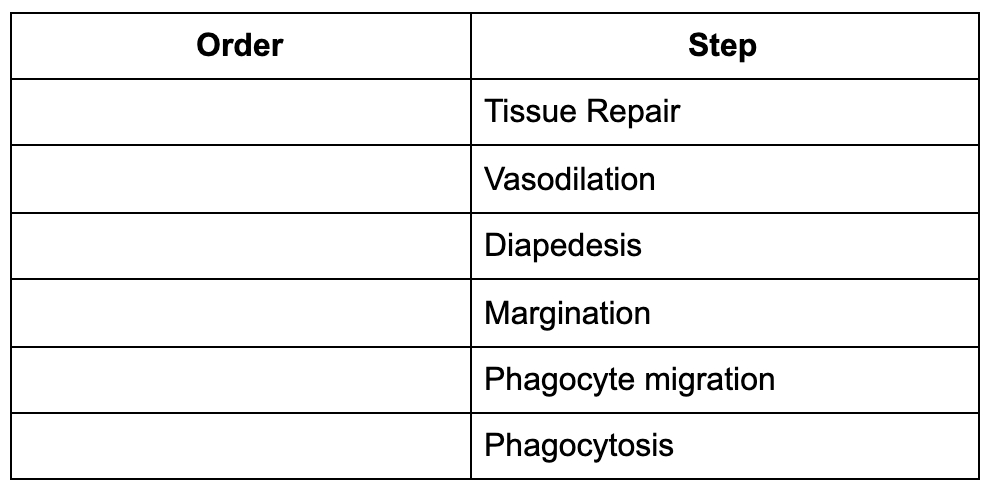
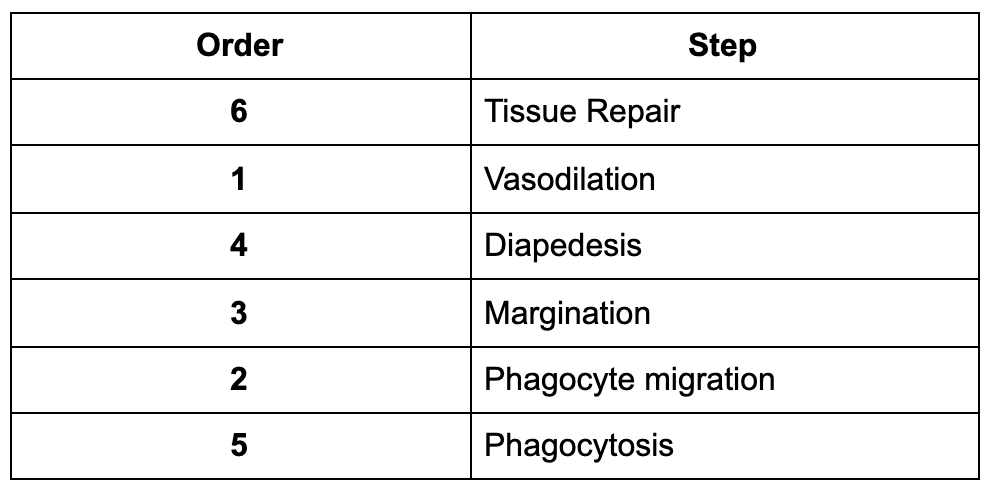
Place the steps in the right order. Fill in the blanks with numbers 1-6.

back 60

front 61

An abnormally high body temperature is called a ________.

  • hypothermia
  • fever
  • cytokine storm
  • shock response

back 61

fever

front 62

Which of the following is an effect of opsonization?

  • cytolysis
  • increased diapedesis of phagocytes
  • inflammation
  • increased adherence of phagocytes to microorganisms
  • increased margiation of phagocytes

back 62

increased adherence of phagocyres to microorganisms

front 63

All of the following protect the skin and mucous membranes from infection except

  • multiple layers of cells
  • the "ciliary escalator"
  • saliva
  • HCI
  • tears

back 63

HCI

front 64

All of the following are effects of kinins except

  • drawing in neutrophils to infected or injure area
  • increased blood vessels permeability
  • chemotaxis of phagocytic granulocytes
  • production of antibodies
  • vasodilation

back 64

production of antibodies

front 65

Which non-specific defense mechanism is mismatched with its associated body structure or body fluid?

  • cilary escalator - intestines
  • very acidic pH - stomach
  • cerumen and sebum - ear
  • lysozyme - tears and saliva
  • keratin and tightly packed cells - skin

back 65

cilary escalator - intestines

front 66

TLRs attach to all of the following except

  • PAMPs
  • lipopolysaccharide outer membrane
  • antimicrobial peptides
  • flagellin
  • peptidogylcan

back 66

antimicrobial peptides

front 67

Match the following leukocytes with the correct description

  • Monocytes -
  • Lymphocytes -
  • Basophils -
  • Eosinophils -

back 67

  • Mature into phagocytic macrop
  • Play a role in adaptive immunity
  • Play a role in allergic responses
  • Target parasites and helminths

front 68

The body has two circulatory systems, the lymphatic system and the blood circulatory system

  • True
  • False

back 68

True

front 69

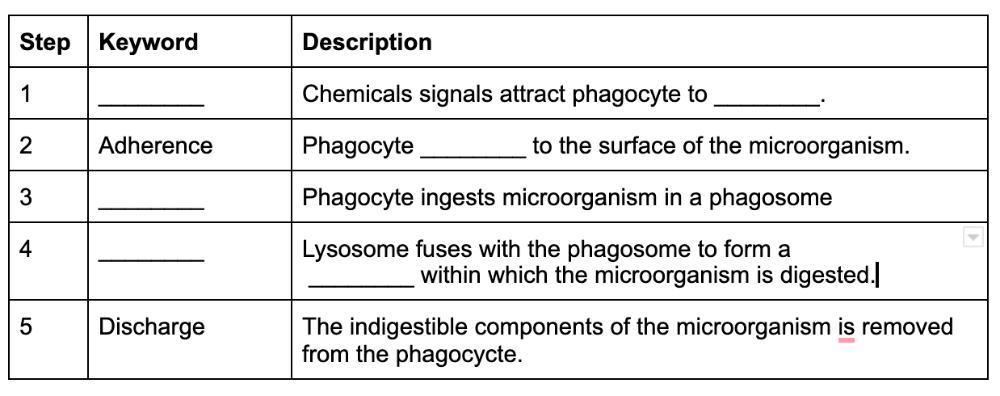
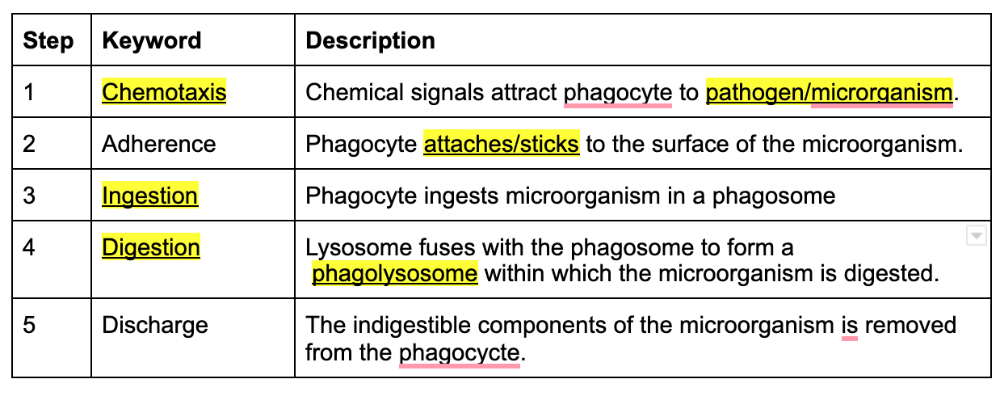
Fill in the following table with the information about phagocytosis

back 69

front 70

Which of the following is the best definition of epitope?

  • specfic regions on antigens that interact with MHC class molecules
  • specific regions on antigens that interact with antibodies
  • specific regions on antigens that interact with haptens
  • specific regions on antigens that interact with perforins
  • specific regions on antigens that interact with T-cell receptors

back 70

specific regions on antigens that interact with antibodies

front 71

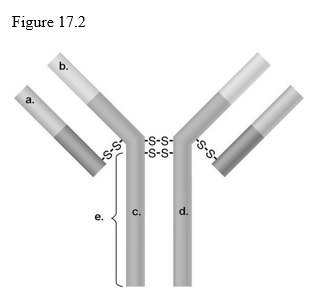
Which areas are different for all IgM antibodies?

  • c and d
  • b and c
  • a and c
  • a nd b

back 71

a and b

front 72

Which of the follwoing is the best defintion of antigen?

  • a pathogen
  • a chemical taht elicts an antibody response and can combine with these antibodies
  • a chemical that combines with antibodies
  • a protein that combines with antibodies
  • something foreign in the body

back 72

a chemical that elicts an antibody response and can combine with these antibodies

front 73

Which of the following statements is NOT a possible outcome of antigen-antibody reaction?

  • neutralization
  • opsonization
  • agglutination
  • clonal deletion
  • activation of complement

back 73

clonal deletion

front 74

When an antibody binds to a toxin, the resulting action is referred to as

  • opsonization
  • agglutination
  • neutralization
  • apoptosis

back 74

neutralization

front 75

Which of the following recognizes antigens displayed on host cells with MHC II?

  • basophil
  • TH cell
  • natural killer cell
  • TC cell
  • B cell

back 75

TH cell

front 76

Which of the following destroys virus-infected cells?

  • TH
  • CTL
  • B cells
  • T reg
  • dendritic cells

back 76

CTL

front 77

The specificity of an antibody is due to

  • the H chains
  • the constant portions of the H and L chains
  • its valence
  • the variable portions of the H and L chains
  • the L chains

back 77

the variable portions of the H and L chains

front 78

Which one of the following causes transmembrane channels in target cells?

  • IL-1
  • IL-2
  • granzymes
  • hapten
  • perforin

back 78

perforin

front 79

Which of the following is NOT a characteristic of B cells?

  • They have antibodies on their surfaces
  • They recognize antigens associated with MHC I.
  • They originate in bone marrow.
  • They are responsible for the memory response.
  • They are responsible for antibody formation.

back 79

They recognize antigens associated with MHC I.

front 80

Which of the following is NOT a characteristic of cellular immunity?

  • Response to abnormal cells
  • The cells originate in bone marrow
  • Cells mature in the thymus gland
  • B cells make antibodies
  • T cells interact with epitiopes in MHC molecules

back 80

B cells make antibodies

front 81

Which areas are similar for all IgG antibodies?

  • a and c
  • b and c
  • a and b
  • c and d
  • b an d

back 81

c and d

front 82

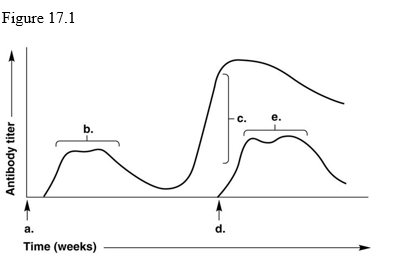
Which letter on the graph indicates the patient's secondary response to a repeated exposure with the identical antigen?

  • b
  • c
  • a
  • d

back 82

c

front 83

Which of the following is not a professional antigen-presenting cell?

  • T cells
  • Dendritic cells
  • B cells
  • Macrophages

back 83

T cells

front 84

Which of the following recognizes antigens displayed on host cells with MHC II?

  • natural killer cell
  • Cytotoxin T cell
  • Helper T cell
  • basophil
  • regulatory T cell

back 84

Helper T cell

front 85

ADCC is a process that is most effective in destroying

  • bacterial toxins
  • eukaryotic pathogens
  • extracellular viruses
  • prions
  • bacterial pathogens

back 85

eukaryotic pathogens

front 86

Which of the following WBCs are not lymphocytes?

  • macrophages
  • helper t cells
  • NK cells
  • B cells
  • cytotoxic t cells

back 86

macrophages

front 87

Which of the following is involved in ensuring that a mother's antibodies do not react against her fetus?

  • Helper T cells
  • Cytotoxic T lymphocytes
  • Treg cells
  • Antigen presenting cells

back 87

Treg cells

front 88

Which of the following is the best definition of antigen?

  • a molecule that can bind to antibodies and cause more antibodies to be produced
  • something foreign in the body
  • a pathogen
  • a virus
  • a protein that combines with antibodies

back 88

a molecule that can bind to antibodies to be produced

front 89

Please match the type of immunity with correct example

  1. Naturally acquired active immunity -
  2. Naturally acquired passive immunity -
  3. Artificially acquired active immunity -
  4. Artificially acquired passive immunity

back 89

  1. Recovery from mumps
  2. A baby receives antibodies from
  3. Vaccination
  4. A susceptible individual recieving

front 90

PLease match each of the following descriptions to the right class of antibodies

  1. Large antibodies that cause agglutination of pathogens
  2. Found in mucus, tears and saliva
  3. Respond and bind to parasitic worms
  4. First to respond to an infection
  5. Able to cross the placenta

back 90

  1. IgM
  2. IgA
  3. IgE
  4. IgM
  5. IgG

front 91

The secondary immune response takes longer to be activated compared to primary immune response.

  • True
  • False

back 91

False

front 92

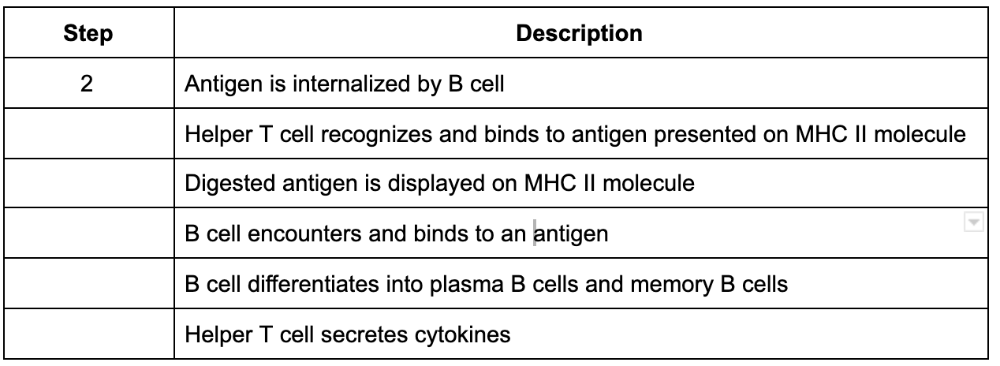
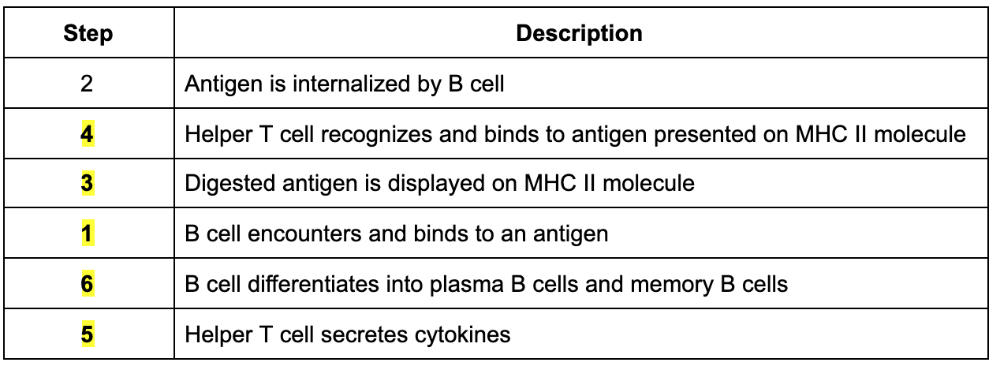
Arrange the following steps of B cell activation in the right order.

back 92