Print Options

Card layout: ?

← Back to notecard set|Easy Notecards home page

Instructions for Side by Side Printing
  1. Print the notecards
  2. Fold each page in half along the solid vertical line
  3. Cut out the notecards by cutting along each horizontal dotted line
  4. Optional: Glue, tape or staple the ends of each notecard together
  1. Verify Front of pages is selected for Viewing and print the front of the notecards
  2. Select Back of pages for Viewing and print the back of the notecards
    NOTE: Since the back of the pages are printed in reverse order (last page is printed first), keep the pages in the same order as they were after Step 1. Also, be sure to feed the pages in the same direction as you did in Step 1.
  3. Cut out the notecards by cutting along each horizontal and vertical dotted line
To print: Ctrl+PPrint as a list

8 notecards = 2 pages (4 cards per page)

Viewing:

Week 9 Quiz

front 1

The pink color in the top of the broth in an FTM tube indicates

  • the presence of oxygen
  • the presence of carbon dioxide
  • the presence of thioglycolate
  • the absence of oxygen

back 1

  • the presence of oxygen

front 2

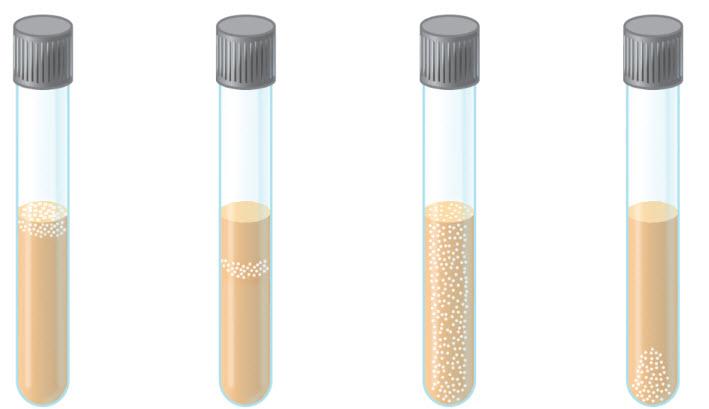
Label these FTM tubes to demonstrate your understanding of the growth patterns of different organisms based on their metabolic need for or sensitivity to oxygen.

  • capnophilic
  • facultative
  • fermentor
  • microaerophilic
  • anaerobic
  • aerobic

back 2

  1. Aerobic
  2. Microaerophilic
  3. Facultative
  4. Anaerobic

front 3

Taq polymerase is a DNA polymerase enzyme that demonstrates maximal activity at 72°C. The organism from which this enzyme was isolated would most likely be classified as a

  • mesophile
  • psychrophile
  • psychrotroph
  • hyperthermophile
  • thermophile

back 3

  • thermophile

front 4

Both human pathogens and normal microbiota are typically classified as

  • mesophiles
  • psychrophiles
  • thermophiles
  • hyperthermophiles

back 4

  • mesophiles

front 5

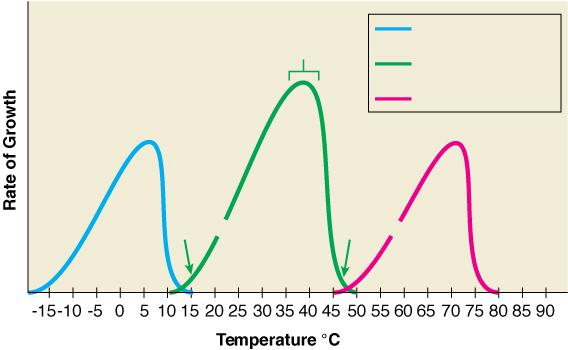
Please label the image to test your understanding of temperature adaptations exhibited by two various bacteria.

  • Minimum
  • Optimum
  • Thermophile
  • Maximum
  • Psychrophile
  • Mesophile

back 5

  1. Minimum
  2. Optimum
  3. Maximum
  4. Psychrophile
  5. Mesophile
  6. Thermophile

front 6

Which parts of a cell are affected by temperature?

  • DNA
  • enzymes
  • RNA
  • membrane fluidity
  • ribosomes

back 6

  • enzymes
  • membrane fluidity
  • ribosomes

front 7

Match the description with the term to demonstrate your understanding of temperature classifications

  1. These organisms are likely to inhabit a compost pile that is actively composting.
  2. The bacteria that grow in and on the human body are in this group.
  3. These organisms might grow in the superheated water near hydrothermal vents in the ocean floor
  4. These organisms might be isolated from water pools on the surface of a glacier.
  • psychrophile
  • thermophile
  • mesophile
  • hyperthermophile

back 7

  1. thermophile
  2. mesophile
  3. hyperthermophile
  4. psychrophile

front 8

______ optimum growth temperature: −5°C–20°C

______ optimum growth temperature: 20°C–50°C

______ optimum growth temperature: 50°C–80°C

______ optimum growth temperature: 80°C– >100°C

  • thermophile
  • psychrophile
  • hyperthermophile
  • mesophile

back 8

  1. psychrophile
  2. mesophile
  3. thermophile
  4. hyperthermophile