Instructions for Side by Side Printing
- Print the notecards
- Fold each page in half along the solid vertical line
- Cut out the notecards by cutting along each horizontal dotted line
- Optional: Glue, tape or staple the ends of each notecard together
Quiz 3 -
front 1 Balance the following chemical equation (if necessary) for the combustion reaction of propane: C₃H₈(g) + O₂(g) → CO₂(g) + H₂O(g) | back 1 C₃H₈(g) + 5O₂(g) → 3CO₂(g) + 4H₂O(g) |
front 2 Balance the following chemical equation (if necessary): C₃H₆(g)+O₂(g)→CO₂(g)+H₂O(g) | back 2 2 C₃H₆(g) + 9 O₂(g) → 6 CO₂(g) + 6 H₂O(g) |
front 3 Balance the following chemical equation (if necessary): H₂SO₄(aq)+Pb(OH)₄(s)→Pb(SO₄)₂(s)+H₂O(l) | back 3 2H₂SO₄(aq) + Pb(OH)₄(s) → Pb(SO₄)₂(s) + 4H₂O(l) |
front 4 Balance the following chemical equation (if necessary): Si₂H₃(s)+O₂(g)→SiO₂(g)+H₂O(g) | back 4 4 Si₂H₃(s) + 11 O₂(g) → 8 SiO₂(g) + 6 H₂O(g) |
front 5 Balance the following chemical equation (if necessary): KOH(aq)+H₂S(aq)→H₂O(l)+K₂S(aq) | back 5 2KOH(aq) + H₂S(aq) → 2H₂O(l) + K₂S(aq) |
front 6 Balance the following chemical equation (if necessary): Zn(s)+AgNO₃(aq)→Ag(s)+Zn(NO₃)₂(aq) | back 6 Zn(s) + 2AgNO₃(aq) → 2Ag(s) + Zn(NO₃)₂(aq) |
front 7 Balance the following chemical equation (if necessary): KClO₃(s)→KCl(s)+O₂(g) | back 7 2KClO₃(s)→ 2KCl(s) + 3O₂(g) |
front 8 Write a balanced chemical equation based on the following description: aqueous iridium(III) bromide reacts with aqueous silver acetate to form solid silver bromide and aqueous iridium(III) acetate | back 8 IrBr₃(aq) + 3 AgC₂H₃O₂(aq) → 3 AgBr(s) + Ir(C₂H₃O₂)₃(aq) |
front 9 Write a balanced chemical equation based on the following description: gaseous nitrogen and hydrogen react to form gaseous ammonia | back 9 N₂(g) + 3 H₂(g) → 2 NH₃(g) |
front 10 Write a balanced chemical equation based on the following description: solid potassium oxide reacts with liquid water to produce aqueous potassium hydroxide | back 10 K₂O(s) + H₂O(l) → 2 KOH(aq) |
front 11 Write a balanced chemical equation based on the following description: the reaction of solid carbon with oxygen gas to form carbon dioxide gas. | back 11 C(s) + O₂(g) → CO₂(g) |
front 12 What is the coefficient in front of the NO when the equation below is balanced? NH₃(g) + O₂ (g) → NO(g) + H₂O (g) | back 12 4 |
front 13 How many oxygen atoms are located on the reactant side of the following chemical equation? 2 Al(s) + Fe₂O₃(s) → Al₂O₃(s) + 2 Fe(l) A) 1 B) 2 C) 3 D) 4 E) 5 | back 13 C) 3 |
front 14 Which of the following represents the generic form of a single-displacement reaction? A) A + BX → AX + B B) AB → A + B C) AX + BY → AY + BX D) A + B → AB | back 14 A) A + BX → AX + B |
front 15 Which of the following represents the generic form of a synthesis reaction? A) A + BX → AX + B B) A + B → AB C) AB → A + B D) AX + BY → AY + BX | back 15 B) A + B → AB |
front 16 Which of the following reactions is a double displacement reaction? A) HCl (g) → H₂ (g) + Cl₂ (g) B) HCl (aq) + NaOH (aq) → H₂O (l) + NaCl (aq) C) Mg (s) + 2HCl (aq) → MgCl₂ (aq) + H₂ (g) D) HCl (g) + C₅H₁₀ (g) →C₅H₁₁Cl (g) | back 16 B) HCl (aq) + NaOH (aq) → H₂O (l) + NaCl (aq) |
front 17 What type of reaction is represented by the following equation: C₄H₈(g) + 6O₂(g) → 4CO₂(g) + 4H₂O(g) A) acid-base B) decomposition C) precipitation D) redox (oxidation-reduction) | back 17 D) redox (oxidation-reduction) |
front 18 What type of reaction is represented by the following equation: SiCl₄(l) + 2Mg(s) → 2MgCl₂(s) + Si(s) A) combination B) decomposition C) double displacement D) single displacement | back 18 D) single displacement |
front 19 In the following reaction, which element in what species is oxidized? C₂H₄ (g) + 3 O₂ (g) → 2 CO₂ (g) + 2 H₂O (g) A) C in C₂H₄ B) H in C₂H₄ C) O in O₂ D) This is not an oxidation/reduction type of reaction.+ | back 19 A) C in C₂H₄ |
front 20 In the following reaction, which element in what species is reduced? Zn (s) + 2 HCl (aq) → ZnCl₂ (aq) + H₂ (g) A) Zn B) H in HCl C) Cl in HCl D) This is not an oxidation/reduction type of reaction. | back 20 B) H in HCl |
front 21 Determine the mass, in grams, of 0.400 moles of Pb (1 mol of Pb has a mass of 207.2 g). | back 21 82.9 g |
front 22 Determine the number of atoms in 51.0 grams of sodium, Na. (The mass of one mole of sodium is 22.99 g.) | back 22 1.34 × 10²⁴ atoms |
front 23 How many moles of calcium atoms do you have if you have 3.00 × 10²¹ atoms of calcium. (The mass of one mole of calcium is 40.08 g.) | back 23 0.00498 mol |
front 24 Determine the molar mass of Ag₃N. | back 24 337.62 g/mol |
front 25 How many moles of hydrogen are in 3.06 × 10⁻³g of glycine, C₂H₅NO₂? | back 25  2.04 × 10⁻⁴ mol H. |
front 26 How many hydrogen atoms are in 0.1488g of phosphoric acid, H₃PO₄? | back 26 2.743 × 10²¹ atoms H. |
front 27 How many atoms are in 1.2 mol of carbon? | back 27 7.2 × 10²³ atoms |
front 28 Which of the following contains the most moles of atoms? A) 1 g of helium B) 1 g of carbon C) 1 g of uranium D) All contain equal number of atoms E) Not enough information+ | back 28 A) 1 g of helium |
front 29 Determine the number of atoms of O in 7.23 moles of Ca(NO₃)₂. | back 29 2.61 × 10²⁵ atoms |
front 30 What is the mass grams that are in 1 molecule of H₂? | back 30 3.34 × 10⁻²⁴ g |
front 31 According to the balanced reaction below, calculate the moles of NO₂ that form when 5.20 × 10⁻³mol of N₂O₅ completely reacts: 2N₂O₅(g)→4NO₂(g)+O₂(g) | back 31 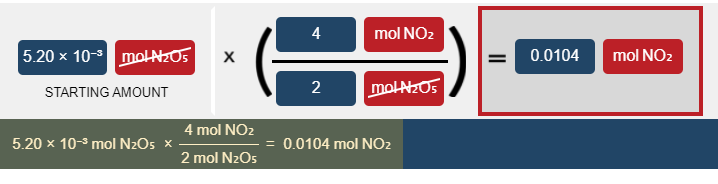 0.0104 mol NO₂. |
front 32 Determine the number of molecules of Cr₂O₃thatformwhen1.34 × 10³g of oxygen completely reacts according to the following equation: 4Cr(s)+3O₂(g)→2Cr₂O₃(s) | back 32 1.68 × 10²⁵ molecules Cr₂O₃. |
front 33 How many moles of MnO₃ are produced when 4.30kg of oxygen gas completely reacts according to the balanced chemical reaction: 2Mn(s)+3O₂(g)→2MnO₃(s) | back 33 89.6 mol MnO₃. |
front 34 How many moles of nitrogen gas would be produced if 3.40 moles of copper(II) oxide were reacted with excess ammonia in the following chemical reaction? 2 NH₃(g) + 3 CuO (s) → 3 Cu(s) + N₂(g) + 3 H₂O(g) | back 34 1.13 mol |
front 35 What is the mass in grams of NO that will be produced from 30.0 g of NO₂ reacted with excess water in the following chemical reaction? 3 NO₂(g) + H₂O(l) → 2 HNO₃(g) + NO(g) | back 35 6.52 g |
front 36 If you have 5 mol H₂ and 2 mol N₂, what is the limiting reagent in the reaction below? 3 H₂(g) + N₂ (g) → 2 NH₃ (g) A) H₂ B) N₂ C) NH₃ D) Both reactants are limiting. | back 36 A) H₂ |
front 37 If 50.0 g of H₂ and 100.0 g of O₂ react, how many moles of H₂O can be produced in the reaction below? 2 H₂(g) + O₂(g) → 2 H₂O(g) | back 37 6.250 mol |
front 38 If 34.7 g of AgNO₃ react with 28.6 g of H₂SO₄ according to this UNBALANCED equation below, what is the mass in grams of Ag₂SO₄ that could be formed? AgNO₃(aq) + H₂SO₄ (aq) → Ag₂SO₄ (s) + HNO₃ (aq) | back 38 31.8 g |
front 39 If 10.0 moles of O₂ are reacted with excess NO in the reaction below, and only 4.2 mol of NO₂ were collected, then what is the percent yield for the reaction? 2 NO (g) + O₂ (g) → 2 NO₂ (g) | back 39 21 % |
front 40 In the reaction below, 7.0 mol of NO and 5.0 mol of O₂ are reacted together. The reaction generates 3.0 mol of NO₂. What is the percent yield for the reaction? 2 NO (g) + O₂ (g) → 2 NO₂ (g) | back 40 43 % |
front 41 Convert 475 cal to joules | back 41 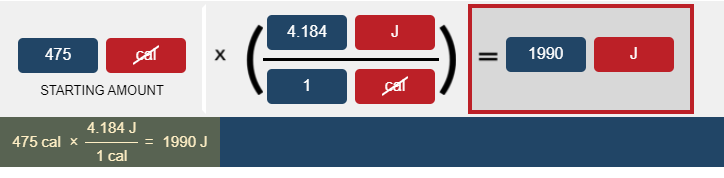 1990 J |
front 42 How many Joules are there in 2001 calories? (1 cal = 4.184 J) | back 42 8.372 × 10³ J |
front 43 How many calories are in 1001 kJ ? (1 cal = 4.184 J) | back 43 2.392 × 10⁵ cal |
front 44 When molecules absorb heat, there is an increase in A) the kinetic energy of the molecules. B) The potential energy of the molecules. C) The mass of the molecules. D) The bond energy of the molecules. | back 44 A) the kinetic energy of the molecules. |
front 45 Which of the following represents an example of kinetic energy? A) a ball at the top of a hill. B) A ball rolling down a hill. C) A ball at the bottom of a hill. | back 45 B) A ball rolling down a hill. |
front 46 Which one of the following processes is exothermic? A) Boiling a liquid. B) Condensation of a gas into a liquid. C) Melting a solid. D) Converting solid into gas. | back 46 B) Condensation of a gas into a liquid. |
front 47 In which one of the following processes is the system endothermic? A) A process in which the air around the reaction becomes warmer. B) A process taking place in solution where the solution temperature decreases. C) The combustion of natural gas. D) The formation of frost on a window. | back 47 B) A process taking place in solution where the solution temperature decreases. |
front 48 Which one of the equations below is an endothermic reaction? A) SrO (s) + CO₂ (g) → SrCO₃ (s)∆H° = -234 kJ/mol B) H₂ (g) + F₂ (g) → 2 HF (g) ∆H° = -79.2 kJ/mol C) H₂ (g) + C (s) + N₂ (g) → 2 HCN (g) ∆H° = 270.3 kJ/mol D) 2 K (s) + 2 H₂O (l) → 2 KOH (aq) + H₂ (g) ∆H° = -393.1 kJ/mol | back 48 C) H₂ (g) + C (s) + N₂ (g) → 2 HCN (g) ∆H° = 270.3 kJ/mol |
front 49 If a reaction favors products over reactants more as heat is added, that reaction is: A) exothermic B) endothermic C) isobaric D) isochoric | back 49 B) endothermic |
front 50 How much heat (in kJ) will be absorbed by a 50.3 g piece of aluminum (specific heat = 0.930 J/g・°C) as it changes temperature from 23.0°C to 67.0°C? | back 50 2.06 kJ |
front 51 An unknown solid is added to water in a calorimeter. The temperature of the water increases. What does this say about the reaction? A) The reaction is exothermic. B) The reaction is endothermic. C) The reaction has absorbed heat from the solution. D) The reaction has released heat to the solution. E) Both A and D. | back 51 E) Both A and D. |
front 52 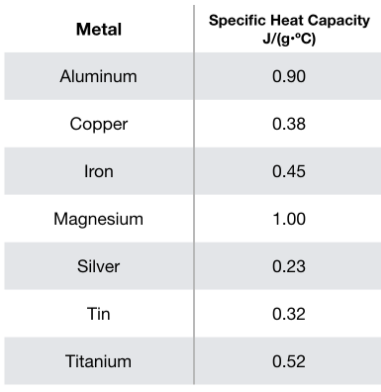 hat is the identity of a 100. g sample of metal that, upon absorbing 4680 J of heat, increases in temperature by 52.0°C? A) Mg B) Al C) Ti D) Fe | back 52 B) Al |
front 53 Which one of the following phase changes would be exothermic? A) freezing B) boiling C) sublimation D) melting | back 53 A) freezing |