Instructions for Side by Side Printing
- Print the notecards
- Fold each page in half along the solid vertical line
- Cut out the notecards by cutting along each horizontal dotted line
- Optional: Glue, tape or staple the ends of each notecard together
Week 7 - Chemistry
front 1 etermine the number of grams of C₄H₁₀ that are required to completely react to produce 8.70mol of CO₂ according to the following combustion reaction: 2C₄H₁₀(g)+13O₂(g)→8CO₂(g)+10H₂O(g) | back 1  The correct answer is 126 g C₄H₁₀. |
front 2 Determine the number of grams of HCl that can react with 0.750g of Al(OH)₃ according to the following reaction Al(OH)₃(s)+3HCl(aq)→AlCl₃(aq)+3H₂O(aq) | back 2  The correct answer is 1.05 g HCl. |
front 3 How many grams of oxygen gas are produced when 2.43 × 10⁻⁴g of KClO₃ are completely reacted according to the following chemical equation: 2KClO₃(s)→2KCl(s)+3O₂(g) | back 3 9.52 × 10⁻⁵ g O₂. |
front 4 How many grams of nitric acid, HNO₃ ,are required to neutralize (completely react with) 4.30g of Ca(OH)₂according to the acid-base reaction: 2HNO₃(aq)+Ca(OH)₂(aq)→2H₂O(l)+Ca(NO₃)₂(aq) | back 4  The correct answer is 7.31 g HNO₃. |
front 5 How many moles of NH₃ can be produced from 3.76 moles of nitrogen in the following reaction: N₂ (g) + 3 H₂ (g) → 2 NH₃ (g) | back 5 7.52 mol |
front 6 How many moles of Al are necessary to form 28.6 g of AlBr₃ from this reaction: 2 Al(s) + 3 Br₂(l) → 2 AlBr₃(s) ? | back 6 0.107 mol |
front 7 What is the mass in grams of H₂ that can be formed from 54.6 grams of NH₃ in the following reaction? 2 NH₃(g) → 3 H₂(g) + N₂(g) | back 7 9.71 g |
front 8 How many moles of HNO₃ will be produced from the reaction of 45.0 g of NO₂ with excess water in the following chemical reaction? 3 NO₂(g) + H₂O (l) → 2 HNO₃(g) + NO(g) | back 8 0.652 mol |
front 9 How many moles of lithium hydroxide would be required to produce 38.5 g of Li₂CO₃ in the following chemical reaction? 2 LiOH(s) + CO₂(g) → Li₂CO₃(s) + H₂O(l) | back 9 1.04 mol |
front 10 Milk of magnesia, which is an aqueous suspension of magnesium hydroxide, is used as an antacid in the reaction below. How many molecules of HCl would have to be present to form 75.82 g of MgCl₂? Mg(OH)₂(s) + 2 HCl(aq) → 2 H₂O(l) + MgCl₂(aq) | back 10 9.591 × 10²³ molecules |
front 11 Consider the following reaction: C₆H₁₄ + 19/2O₂ → 7H₂O + 6CO₂. Here, C₆H₁₄ is a(n): A) Reactant B) Product C) Hydrocarbon D) Ion E) Both (A) and (C)+ | back 11 E) Both (A) and (C) |
front 12 If you have 1 mol Xe and 1 mol F₂, how many moles of XeF₄ can you create in the following chemical reaction? Xe (g) + 2 F₂ (g) → XeF₄ (g) A) 2 mol B) 1 mol C) 0.5 mol D) 0.25 mol+ | back 12 C) 0.5 mol |
front 13 f 2.00 moles of H₂ and 1.55 moles of O₂ react how many moles of H₂O can be produced in the reaction below? 2 H₂(g) + O₂(g) → 2 H₂O(g) | back 13 2.00 mol |
front 14 If 0.200 moles of AgNO₃ react with 0.155 moles of H₂SO₄ according to this UNBALANCED equation below, what is the mass in grams of Ag₂SO₄ that could be formed? AgNO₃(aq) + H₂SO₄ (aq) → Ag₂SO₄ (s) + HNO₃ (aq) | back 14 31.2 g |
front 15 If 24.7 g of NO and 13.8 g of O₂ are used to form NO₂, how many moles of excess reactant will be left over? 2 NO (g) + O₂ (g) → 2 NO₂ (g) | back 15 0.020 mol |
front 16 If 25.0 g of NH₃ and 45.0 g of O₂ react in the following reaction, what is the mass in grams of NO that will be formed? 4 NH₃ (g) + 5 O₂ (g) → 4 NO (g) + 6 H₂O (g) | back 16 33.8 g |
front 17 What is the difference between actual yield and theoretical yield? A) Actual yield has to do only with the reactants of a reaction, and theoretical yield has to do only with the products of a reaction. B) Actual yield is how much is actually produced in a reaction (it has to be given or measured), and theoretical yield is a calculation that has to be done. C) Actual yield is how much the reaction produces, and theoretical yield is how much a reaction consumes. D) Actual yield has to do with how much you can actually get out of a reaction, and theoretical yield is how much you can get out of a reaction if you have maximum starting materials. | back 17 B) Actual yield is how much is actually produced in a reaction (it has to be given or measured), and theoretical yield is a calculation that has to be done. |
front 18 You have 2.2 mol Xe and 2.0 mol F₂, but when you carry out the reaction you end up with only 0.25 mol XeF₄. What is the percent yield of this experiment? Xe(g) + 2 F₂ (g) → XeF₄ (g) | back 18 25 % |
front 19 In this reaction: Mg (s) + I₂ (s) → MgI₂ (s) If 2.34 moles of Mg react with 3.56 moles of I₂, and 1.76 moles of MgI₂ form, what is the percent yield? | back 19 75.2 % |
front 20 In this reaction: Mg (s) + I₂ (s) → MgI₂ (s), if 10.0 g of Mg reacts with 60.0 g of I₂, and 57.84 g of MgI₂ form, what is the percent yield? | back 20 88.1 % |
front 21 What mass (in grams) of aspirin (C₉H₈O₄) is produced from 57.6 g of C₇H₆O₃ assuming 95.0% yield from the reaction below? C₇H₆O₃ (s) + C₄H₆O₃ (s) → C₉H₈O₄ (s) + HC₂H₃O₂ (aq). | back 21 71.4 g |
front 22 When copper is heated with an excess of sulfur, copper(I) sulfide is formed. In a given experiment, 1.50 g of copper was heated with excess sulfur to yield 1.76 g copper(I) sulfide. What is the percent yield? | back 22 93.7 % |
front 23 Which of the following has the greatest amount of potential energy? A) a ball at the top of a hill. B) A ball rolling down a hill. C) A ball at the bottom of a hill. D) A ball thrown up and moving into the air. | back 23 A) a ball at the top of a hill. |
front 24 Which of the following represents an example of kinetic energy? A) a ball at the top of a hill. B) A ball rolling down a hill. C) A ball at the bottom of a hill. | back 24 B) A ball rolling down a hill. |
front 25 Convert 23.4 kJ to calories | back 25 5590 cal. |
front 26 Convert 3.20 × 10⁴ J to kilo joules 3.20 × 10⁴J | back 26 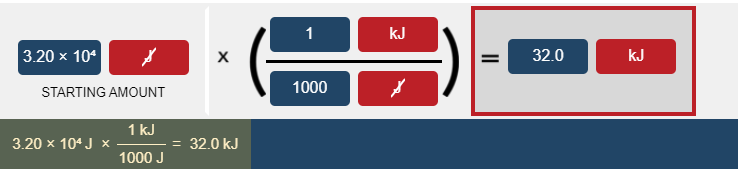 The correct answer is 32.0 kJ. |
front 27 The calorie is defined based on the specific heat capacity of what substance? A) H₂O B) Al C) Pb D) NH₃ E) Hg | back 27 A) H₂O |
front 28 How many calories are in 5401 J ? (1 cal = 4.184 J) | back 28 1.291 × 10³ cal |
front 29 Which of the following units of energy is defined as the heat it takes to raise the temperature of 1 gram of water by 1° C? A) kilojoule B) joule C) watt D) kilocalorie E) calorie | back 29 E) calorie |
front 30 The standard enthalpy of formation for one mole of methanol (CH₃OH) is -239 kJ. What is this value in kcal (1 cal = 4.18 J)? A) Not enough info B) -57.2 kcal C) -0.0175 kcal D) -57,200 kcal E) -239,000 kcal | back 30 B) -57.2 kcal |
front 31 An exothermic reaction causes the surroundings to A) warm up B) become acidic C) condense D) decrease in temperature E) release CO₂ | back 31 A) warm up |
front 32 Which one of the following processes is endothermic? A) Boiling a liquid. B) Freezing a solid. C) Condensation of a gas into a liquid. D) Condensation of a gas into a solid. | back 32 A) Boiling a liquid. |
front 33 Which one of the following processes is exothermic? A) Making coffee. B) Baking a cake. C) Burning wood in a campfire. D) Photosynthesis. | back 33 C) Burning wood in a campfire. |
front 34 Which one of the equations below is an exothermic reaction? A) CO₂ (g) → C (s) + O₂ (g) ∆H° = 394 kJ/mol B) CaO (s) + H₂O (l) → Ca(OH)₂ (aq) ∆H° = -64 kJ/mol C) C (s) + 2 F₂ (g) → CF₄ (g) ∆H° = 141.3 kJ/mol D) N₂ (g) + O₂ (g) → 2 NO (g) ∆H° = 180.6 kJ/mol | back 34 B) CaO (s) + H₂O (l) → Ca(OH)₂ (aq) ∆H° = -64 kJ/mol |
front 35 Equal amounts of heat are added to equal masses of substances A and B at the same temperature, but substance B gets hotter. What is true of their heat capacities (c)? A) c(A) > c(B) B) c(B) > c(A) C) c(a) = c(B) D) Not enough info | back 35 A) c(A) > c(B) |
front 36 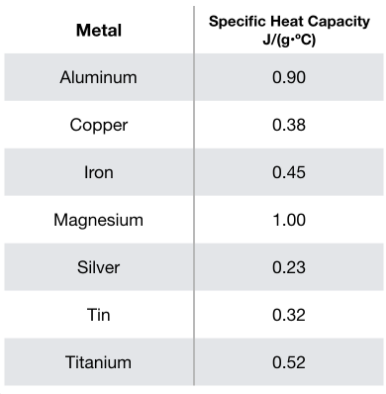 What is the identity of a 100. g sample of metal that, upon absorbing 4680 J of heat, increases in temperature by 52.0°C? A) Mg B) Al C) Ti D) Fe | back 36 B) Al |
front 37 How much heat, in kJ, will be absorbed by a 25.0 g piece of aluminum (specific heat = 0.930 J/g・°C) as it changes temperature from 25.0°C to 76.0°C? A) 5.34 kJ B) 1190 kJ C) 1.19 kJ D) 5340 kJ+ | back 37 C) 1.19 kJ |
front 38 If 801 J of heat is available, what is the mass in grams of iron (specific heat = 0.450 J/g・°C) that can be heated from 22.5°C to 120.0°C? | back 38 18.3 g |
front 39 What is the specific heat of a 75.01 g piece of an unknown metal that exhibits a 45.2°C temperature change upon absorbing 1870 J of heat? | back 39 0.552 J/g・°C |
front 40 A 130.3 g piece of copper (specific heat 0.380 J/g・°C) is heated and then placed into 400.0 g of water initially at 20.7°C. The water increases in temperature to 22.2°C. What is the initial temperature (in °C) of the copper? (The specific heat of water is 4.184 J/g・°C). | back 40 72.9 °C |
front 41 Which of the following phase changes represents sublimation? A) gas ⟶ liquid B) liquid ⟶ gas C) liquid ⟶ solid D) solid ⟶ liquid E) solid ⟶ gas | back 41 E) solid ⟶ gas |
front 42 Which of the following phase changes is endothermic? A) Sublimation B) Deposition C) Freezing D) Condensation | back 42 A) Sublimation |
front 43 Which one of the following phase changes would be exothermic? A) sublimation B) vaporization C) condensation D) melting | back 43 C) condensation |
front 44 Which one of the following phase changes would be endothermic? A) A phase change from a solid to a gas. B) A phase change from a gas to a liquid. C) A phase change from a liquid to a solid. D) None of the above cases are endothermic. | back 44 A) A phase change from a solid to a gas. |
front 45 Which one of the following statements would be true about vaporization? A) It is the phase change from solid to gas. B) It is an endothermic process. C) The liquid must release heat as it becomes a gas. D) None of the above statements are true. | back 45 B) It is an endothermic process. |