Exercise 9: Overview of the Skeleton: Classification and Structure of Bones and Cartilages
sharp,slender process
spine
small rounded projection
tubercle
narrow ridge of bone
crest
large rounded projection
tuberosity
structure supported on neck
head
armlike projection
ramus
rounded, convex projection
condyle
narrow opening
fissure
Canal-like structure
Meatus
Round or oval opening through a bone
Foramen
Shallow depression
Fossa
Air-filled cavity
Sinus
Large, irregularly shaped projection
Trochanter
Raised area on or above a condyle
Epicondyle
Projection or prominence
Process
smooth, nearly flat articular surface
facet
long bones
The four major anatomical classifications of bones are long, short, flat, and irregular. Which category has the least amount of spongy bone relative to its total volume?
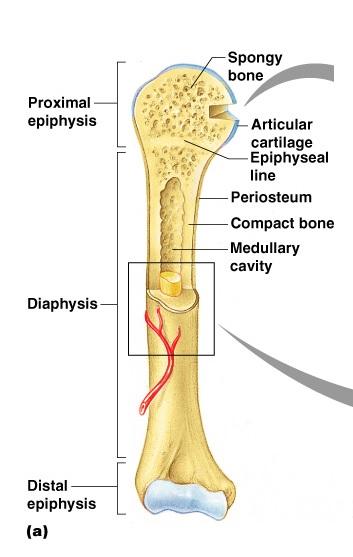
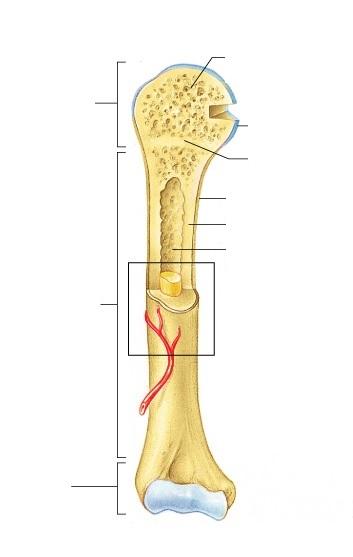
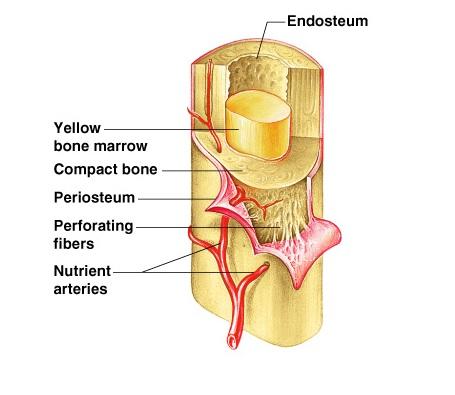
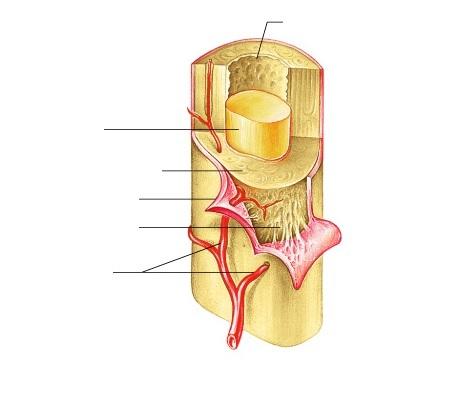
F, epiphysis
contains spongy bone in adults
C, diaphysis
made of compact bone
J, Red Bone Marrow
site of blood cell formation
D, endosteum & I, periosteum
major submembranous site of osteoclasts
C, diaphysis
scientific term for bone shaft
G, Medullary Cavity
contains fat in adult bones
E, Epiphyseal line
growth plate remnant
D, endosteum & I, periosteum
major submembranous site of osteoblasts
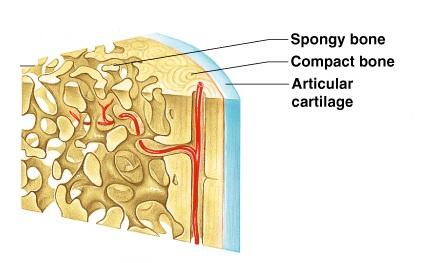
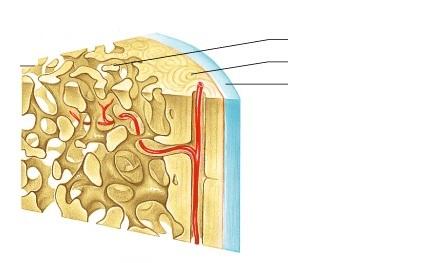
compact bone diaphysis looks solid, practically without holes or gaps-
spongy bone is metaphysis and the epiphysis on the other hand are composed of thousands of spicules or trabeculae of bone, interconnected
What differences between compact and spongy bone can be seen with the naked eye?
The Periosteum serves as an attachment point for muscles and bones through tendons and ligaments.
What is the function of the periosteum?
The path is: Periosteum, Perforating Canals, Central Canals, Canaliculi, Lancunae, Osteocytes
Trace the route taken by nutrients through the bone, starting with the periosteum and ending with an osteocyte in a lacuna.
layers of bony matrix around a central canal
concentric lamellae
site of osteocytes
lacunae
longitudinal canal carrying blood vessels, lymphatics, nerves
central canal
minute canals connecting osteocytes of an osteon
canaliculi
inorganic salts deposited in organic ground substances
matrix
A. Canaliculi
B. Concentric Lamellae
C. Lacunae
D. Central canal
E. Matrix
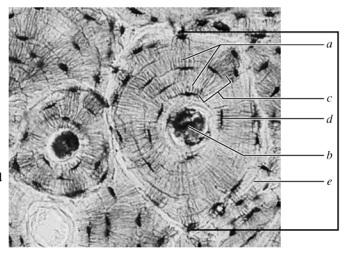
On the photomicrograph of bone on the right (365x), identify all structures maned in the key and bracket an osteon.
Gives bone flexibility & strength
What is the function of the organic matrix in bone?
Collagen fibers, osteocytes
Name the important organic bone components
Gives bone hardness & compressional strength.
Calcium salts form the bulk of the inorganic material in bone. What is the function of the calcium salts?
baking removes what from bone? ORGANIC
soaking in acid removes? MINERALS
Baking removes _______________ from bone. Soaking bone in acid removes _________________.
The cartilage cells at the epiphyseal side are continuing to grow and divide mitotically, while the ones on the diaphyseal side are aging, dying and then osteoblasts move in to form bone.
Compare and contrast events occurring on the epiphyseal and diaphyseal faces of the epiphyseal plate?
Elastic
Type of cartilage that supports the external ear
Fibrocartilage
Type of cartilage between the vertebrae
Hyaline
Type of cartilage that forms the walls of the voice box (larynx)
Elastic
Type of cartilage that forms the epiglottis
Hyaline
Type of cartilage forming the articular cartilages
Fibrocartilage
Type of cartilage that forms the meniscus
Hyaline
Type of cartilage that connects the ribs to the sternum
Fibrocartilage
Type of cartilage thats the most effective at resisting compression
Elastic
The most springy and flexible type of cartilage
Hyaline
The most abundant type of cartilage