front 5 Which of the following statements is true of most angiosperms?
- A) They have a triploid endosperm within the seed.
- B)
They have an ovary that becomes a fruit.
- C) They have a
small (reduced) sporophyte.
- D) They have a triploid
endosperm within the seed and an ovary that becomes a fruit.
| |
front 6 The ovary is most often located on/in the
- A) stamen.
- B) carpel.
- C) petals.
- D)
sepals.
- E) receptacle.
| |
front 7 Microsporangia in flowering plants are located in the
- A) stamen.
- B) carpel.
- C) petals.
- D)
sepals.
| |
front 8 Which of the following is the correct order of floral organs from the
outside to the inside of a complete flower?
- A) petals → sepals → stamens → carpels
- B) sepals →
stamens → petals → carpels
- C) spores → gametes → zygote →
embryo
- D) sepals → petals → stamens → carpels
- E)
male gametophyte → female gametophyte → sepals → petals
| |
front 9 Which of the following floral parts is correctly matched?
- A) anther—microsporangia
- B) petals—protecting floral
parts in unopened buds
- C) sepals—attractive for
insects
- D) stamen—megasporangium
| |
front 10 In some angiosperms, other floral parts contribute to what is
commonly called the fruit. Which of the following fruits is derived
mostly from an enlarged receptacle?
- A) pea
- B) raspberry
- C) apple
- D)
pineapple
- E) peach
| |
front 11 During the process of evolution of an angiosperm,
- A) the sporophyte became larger, more complicated, and short
lived.
- B) the sporophyte became reduced, smaller, simpler,
and long lived.
- C) the gametophyte became reduced, smaller,
simpler, and short lived.
- D) the gametophyte became larger,
simpler, and long lived.
- E) the sporophyte became reduced,
smaller, and long lived.
| |
front 12 Which of the following in an ovule after fertilization is correctly matched?
- A) endosperm—triploid
- B) polar nucleus—diploid
- C) ovule integument—haploid
- D) synergids—diploid
- E) antipodals—diploid
| |
front 13 In a typical dicot ovule, a surviving megaspore divided by ________
consecutive mitotic divisions without cytokinesis results in ________ nuclei.
- A) 2; 6
- B) 3; 8
- C) 3; 12
- D) 4;
16
- E) 1; 1
| |
front 14 In flowering plants, pollen is released from the
- A) anther.
- B) stigma.
- C) carpel.
- D)
filament.
| |
front 15 In the life cycle of an angiosperm, which of the following stages is diploid?
- A) megaspore
- B) generative nucleus of a pollen
grain
- C) polar nuclei of the embryo sac
- D)
microsporocyte
| |
front 16 Where does meiosis occur in a flowering plant?
- A) megasporocyte
- B) microsporocyte
- C) pollen
tube
- D) megasporocyte and microsporocyte
| |
front 17 Which of the following is the correct sequence of processes that
takes place when a flowering plant reproduces?
- A) meiosis → fertilization → ovulation → germination
- B) fertilization → meiosis → nuclear fusion → formation of
embryo and endosperm
- C) meiosis → pollination → nuclear
fusion → formation of embryo and endosperm
- D) growth of
pollen tube → pollination → germination → fertilization
| |
front 18 Which of the following is correctly paired with its life cycle generation?
- A) anther—sporophyte
- B) pollen—sporophyte
- C)
embryo sac—gametophyte
- D) stamen—gametophyte
| |
front 19 A megasporocyte in an angiosperm flower undergoes meiosis and
produces four haploid megaspores. How many survive?
- A) none
- B) one
- C) two
- D) three
| |
front 20 Which of the following pollinating agents is correctly matched with
the type of plant it helps pollinate?
- A) water—terrestrial plants
- B) animals—aquatic
plants
- C) wind—grasses
- D) sand—desert plants
| |
front 21 Which of the following plants is correctly matched with its fruit type?
- A) peas—aggregate
- B) raspberry—simple
- C)
beans—simple
- D) pineapple—accessory
| |
front 22 Apomixis is a mode of ________ in certain plants that allows hybrid
plants to sustain their genome and pass it on to the next generation.
- A) vegetative reproduction
- B) asexual
reproduction
- C) sexual reproduction
- D) fission
| |
front 23 Which of the following occurs in an angiosperm ovule?
- A) An antheridium forms from the megasporophyte.
- B) A
megaspore mother cell (megasporocyte) undergoes meiosis.
- C)
The nucleus forms a diploid egg.
- D) A pollen tube emerges
to accept pollen after pollination.
| |
front 24 In which of the following pairs are the two terms equivalent?
- A) ovule—egg
- B) embryo sac—female gametophyte
- C) endosperm—male gametophyte
- D) seed—zygote
| |
front 25 Which of the following is considered a multiple fruit?
- A) apple
- B) strawberry
- C) raspberry
- D) pineapple
| |
front 26 In flowering plants, a mature male gametophyte contains
- A) two haploid gametes and a diploid pollen grain.
- B)
a generative cell and a tube cell.
- C) two sperm nuclei and
one tube cell nucleus.
- D) two haploid microspores.
| |
front 27 Three mitotic divisions within the female gametophyte of a flowering
plant will produce
- A) three antipodal cells, two polar nuclei, one egg, and two
synergids.
- B) the triple fusion nucleus.
- C) three
pollen grains.
- D) two antipodal cells, two polar nuclei,
two eggs, and two synergids.
| |
front 28 As a flower develops, which transition is most likely to occur?
- A) The microspores become pollen grains.
- B) The ovule
becomes a fruit.
- C) The petals are retained.
- D)
The vegetative nucleus becomes a sperm nucleus.
| |
front 29 The primary function of the integument of an ovule is to
- A) protect against animal predation.
- B) ensure double
fertilization.
- C) form a seed coat.
- D) direct
development of the endosperm.
| |
front 30 Which of the following events suggests there is a change in the egg
cell membrane after penetration by a sperm?
- A) The pollen tube grows away from the egg toward the polar
nuclei.
- B) The Ca2+concentration increases in the cytoplasm
of the egg.
- C) The egg plasmolyzes.
- D) Double
fertilization occurs
| |
front 31 Which of the following is an advantage of flowering plants
maintaining an extended gametophyte generation?
- A) The protection of female gametophytes within ovules keeps
them from drying out.
- B) Sperm with flagella can reach the
egg faster.
- C) It provides sufficient time for the
integument to develop into a seed coat.
- D) It allows for a
complex nucleus to develop.
| |
front 32 What typically results from double fertilization in angiosperms?
- A) The endosperm develops into a diploid nutrient tissue.
- B) A triploid zygote is formed.
- C) Both a diploid
embryo and triploid endosperm are formed.
- D) Two embryos
develop in every seed.
| |
front 33 Which of the following "vegetables" is botanically a fruit?
- A) lettuce
- B) radish
- C) cabbage
- D)
okra
| |
front 34 The embryo of a grass seed is enclosed by two protective sheaths, a
________, which covers the young shoot, and a(n) ________, which
covers the young root.
- A) cotyledon; radicle
- B) hypocotyl; epicotyl
- C) coleoptile; coleorhiza
- D) scutellum; coleoptile
| |
front 35 Seeds develop from
- A) receptacles.
- B) fertilized eggs.
- C)
ovary
- D) ovules.
| |
front 36 What is the first step in the germination of a seed?
- A) pollination
- B) fertilization
- C)
imbibition
- D) hydrolysis of starch and other food
reserves
| |
front 37 Which of the following best describes the ploidy level of a
fertilized embryo sac?
- A) All cells are diploid.
- B) All cells are
triploid.
- C) All cells are polyploid.
- D) There are
haploid, diploid, and triploid cells.
| |
front 38 A parent with an S1S2 genotype exhibiting sporophytic
self-incompatibility can potentially fertilize which of the following
plant genotypes of the same species with pollen grains?
- A) S1S3
- B) S2S3
- C) S3S4
- D)
S1S4
| |
front 39 Which of the following is an effective method to produce plants
exhibiting hybrid vigor?
- A) self-pollination
- B) cloning
- C) tissue
culture
- D) genetic engineering
| |
front 40 Carpellate flowers
- A) are perfect.
- B) are complete.
- C) produce
pollen.
- D) develop into fruits
| |
front 41 Which of the following types of plants are incapable of self-pollination?
- A) dioecious
- B) monoecious
- C) complete
- D) wind-pollinated
| |
front 42 Recent research has shown that fertilization requires that carpels
recognize pollen grains as "self" or "non-self."
For self-incompatibility, the system requires
- A) the rejection of non-self cells.
- B) the rejection
of self cells.
- C) carpel incompatibility with the egg
cells.
- D) that the flowers be incomplete.
| |
front 43 Plant biotechnology is an effective tool for
- A) reducing world hunger.
- B) increasing the import of
oil.
- C) decreasing genetic diversity.
- D) increasing
the incompatibility of fertilization.
| |
front 44 Which of the following is a potential advantage of introducing
apomixis into hybrid crop species?
- A) Cultivars would be better able to cope with a rapidly
changing environment.
- B) They would have a larger potential
genome than inbred crops.
- C) All of the desirable traits of
the cultivar would be passed on to offspring.
- D) They would
benefit from positive mutations in their DNA.
| |
front 45 Which of the following is true about vegetative reproduction?
- A) It involves both meiosis and mitosis to produce haploid and
diploid cells.
- B) It produces vegetables and not
fruits.
- C) It involves meiosis only.
- D) It produces
clones of the parent plant.
| |
front 46 Which of the following is a true statement about clonal reproduction
in plants?
- A) Clones of plants do not occur naturally.
- B) Cloning, although achieved in animals, has not been
demonstrated in plants.
- C) Making cuttings of ornamental
plants is a form of fragmentation.
- D) Reproduction of
plants by cloning may be either sexual or asexual.
| |
front 47 Which of the following statements is true for a species that produces
seeds by apomixis?
- A) The seed coat is made of diploid cells derived from the
ovule of a flower.
- B) The embryo consists of diploid cells
derived from fertilization of a haploid egg by a haploid sperm.
- C) The scutellum is the primary food storage tissue of the
embryo.
- D) A haploid embryo is contained within the
seed.
| |
front 48 Which of the following could be considered an evolutionary advantage
of asexual reproduction in plants?
- A) increased success of progeny in a stable environment
- B) increased agricultural productivity in a rapidly changing
environment
- C) maintenance and expansion of a large
genome
- D) production of numerous progeny
| |
front 49 Biofuels are mainly produced by
- A) the breakdown of cell wall biopolymers into sugars that can
be fermented.
- B) plants that convert hemicellulose into
gasoline.
- C) the genetic engineering of ethanol-generating
genes into plants.
- D) transgenic crops that have cell walls
containing ethylene.
| |
front 50 Which of the following is a scientific concern related to creating
genetically modified crops?
- A) Herbicide resistance may spread to weedy species.
- B) Beneficial insects may be harmed by eating pest species.
- C) Their adaptive advantages would allow them to overpower
natural ecosystems.
D) The monetary costs of growing genetically modified plants are
significantly greater than those of traditional breeding techniques | |
front 51 Due to the limitation of land and water resources on planet earth,
biotechnology can help to increase the crop yields to meet human needs
and demands in the years to come. Farmers have to produce ________%
more grain per hectare to feed human population in ________.
- A) 25; 2035
- B) 40; 2030
- C) 50; 2050
- D) 20; 2030
| |
front 52 What effects would occur in a mutant of Arabidopsis that
cannot synthesize GABA within its flowers?
- A) Pollen tube growth would not be directed toward the egg,
and fertilization would not occur.
- B) The seeds from the
flowers would be unable to break dormancy.
- C) The pollen
grain would not form a pollen tube due to incompatibility with the
pollen tube.
- D) The length of the style would be increased
to the point where the growing pollen tube would be unable to reach
the synergids.
| |
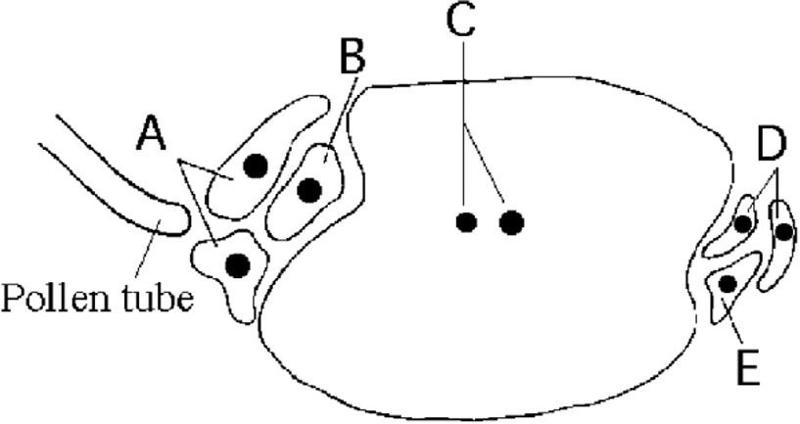
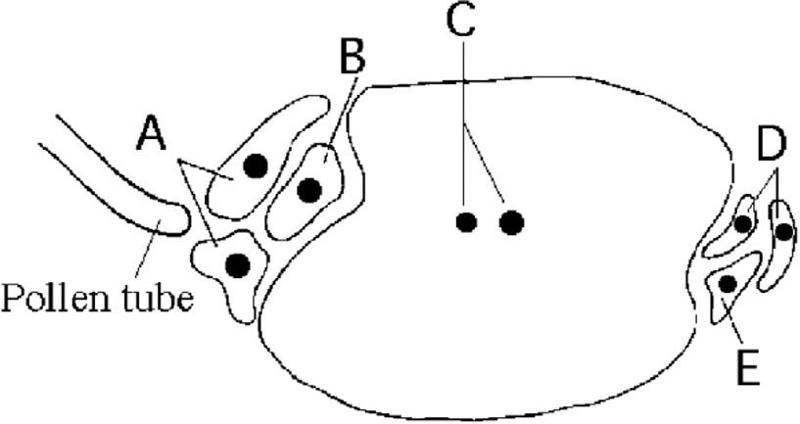
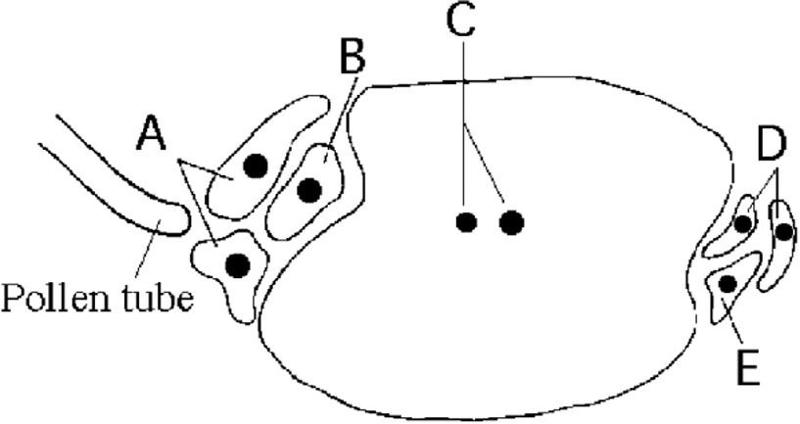
front 53 Based on Figure 30.1, which cell(s), after fertilization, give(s)
rise to the embryo plant?
- A) A
- B) B
- C) C
- D) D
| |
front 54 Based on Figure 30.1, which cell(s) become(s) the triploid endosperm?
- A) A
- B) B
- C) C
- D) D
| |
front 55 Based on Figure 30.1, which cell(s) guide(s) the pollen tube to the
egg cell?
- A) A
- B) B
- C) C
- D) D
| |
front 56 You are studying a plant from the Amazon rain forest that shows
strong self-incompatibility. To characterize this reproductive
mechanism, you would look for
- A) ribonuclease (RNAase) activity in stigma cells.
- B)
RNA in the plants.
- C) pollen grains with very thick
walls.
- D) carpels that cannot produce eggs by meiosis.
- E) systems of wind, but not insect, pollination.
| |
front 57 Regardless of where in the world a vineyard is located, in order for
the winery to produce a Burgundy, it must use varietal grapes that
originated in Burgundy, France. The most effective way for a new
California grower to plant a vineyard to produce Burgundy is to
- A) plant seeds obtained from French varietal Burgundy
grapes.
- B) transplant varietal Burgundy plants from
France.
- C) acquire a tissue culture of varietal Burgundy
grapes from France.
- D) cross French Burgundy grapes with
native American grapes.
- E) graft varietal Burgundy grape
scions onto native (Californian) root stocks.
| |
front 58 Several million people around the world experience malnutrition or
hunger due to lack of nutritious food. Which tool would be most
effective in helping alleviate human malnutrition and hunger?
- A) cloning
- B) crop breeding
- C) tissue
culture
- D) self-pollination
- E) vegetative
reproduction
| |
front 59 A seed develops from an
- A) ovum.
- B) embryo.
- C) ovule.
- D)
ovary.
| |
front 60 A fruit is a
- A) mature ovary.
- B) mature ovule.
- C) seed
plus its integuments.
- D) fused carpel.
| |
front 61 Double fertilization means that
- A) flowers must be pollinated twice to yield fruits and
seeds.
- B) every egg must receive two sperm to produce an
embryo.
- C) one sperm is needed to fertilize the egg, and a
second sperm is needed to fertilize the polar nuclei.
- D)
every sperm has two nuclei.
| |
front 62 "Golden Rice"
- A) is resistant to various herbicides, making it practical to
weed rice fields with those herbicides.
- B) is resistant to
a virus that commonly attacks rice fields.
- C) includes
bacterial genes that produce a toxin that reduces damage from insect
pests.
- D) has a modified genome that includes transgenes that
lead to an increased vitamin A content.
| |
front 63 Which statement concerning grafting is correct?
- A) Stocks and scions refer to twigs of different species.
- B) Stocks and scions must come from unrelated species.
- C) Stocks provide root systems for grafting.
- D)
Grafting creates new species.
| |
front 64 Some dioecious species have the XY genotype for male and XX for
female. After double fertilization, what would be the genotypes of the
embryos and endosperm nuclei?
- A) embryo X/endosperm XX or embryo Y/endosperm XY
- B)
embryo XX/endosperm XX or embryo XY/endosperm XY
- C) embryo
XY/endosperm XXX or embryo XX/endosperm XXY
- D) embryo
XX/endosperm XXX or embryo XY/endosperm XXY
| |
front 65 A small flower with green petals is most likely
- A) bee-pollinated.
- B) bird-pollinated.
- C)
bat-pollinated.
- D) wind-pollinated.
| |
front 66 The pollen produced by wind-pollinated plants is often smaller than
the pollen produced by animal-pollinated plants. A reason for this
might be that
- A) wind-pollinated plants, in general, are smaller than
animal-pollinated plants.
- B) wind-pollinated flowers don't
need large pollen grains because they don't have to attract animal
pollinators.
- C) small pollen grains can be carried farther by
the wind.
- D) animal pollinators are more facile at picking
up large pollengrains.
| |
front 67 The black dots that cover strawberries are actually individual fruits
from a flower with multiple carpels. The fleshy and tasty portion of a
strawberry derives from the receptacle of the flower. Therefore, a
strawberry is both
- A) a multiple fruit and an aggregate fruit.
- B) a
multiple fruit and an accessory fruit.
- C) a simple fruit
and an aggregate fruit.
- D) an aggregate fruit and an
accessory fruit.
| |